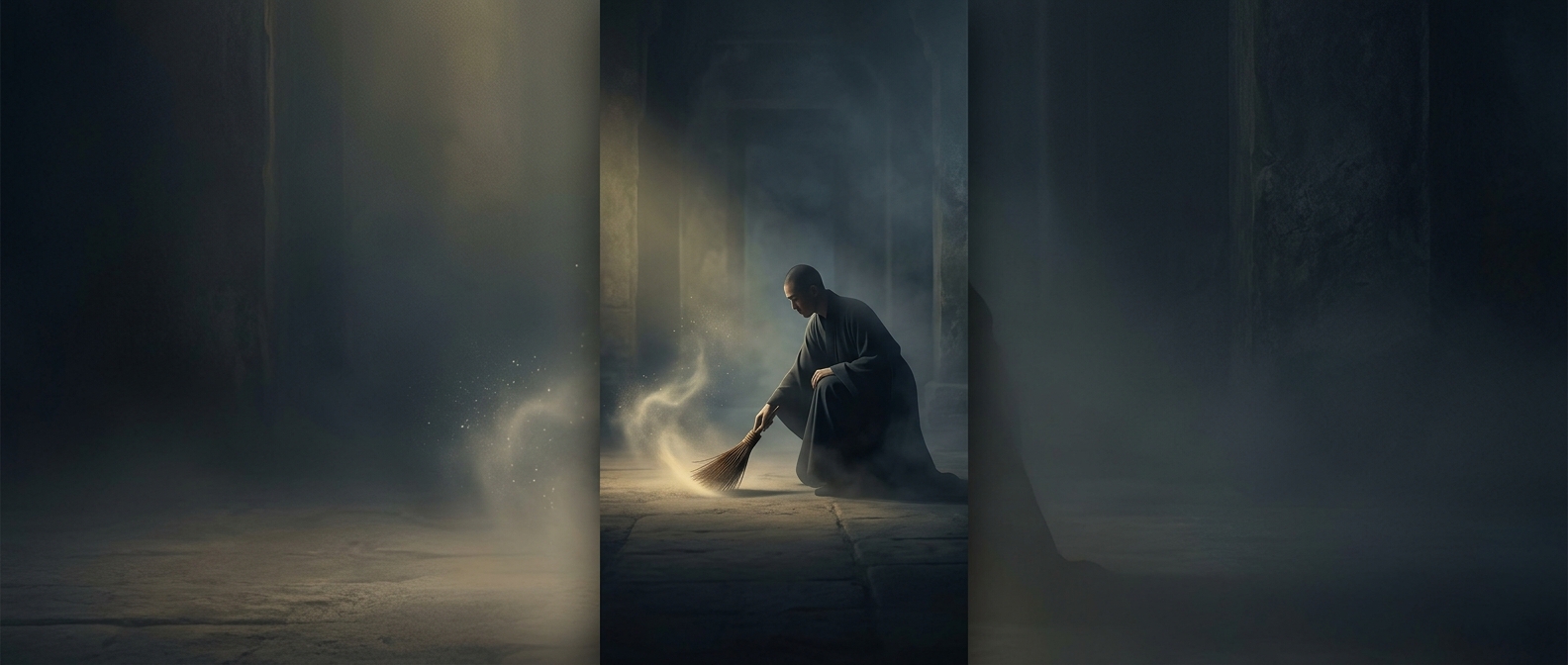
A brush that puts nonviolence underfoot
For some Jain mendicants—religious renunciants who own very little and live by strict vows—a small whisk or broom is part of daily practice. Before placing a foot, they gently sweep the path ahead. The aim is to move tiny creatures out of harm’s way rather than crush them unknowingly.
This practice expresses ahimsa, the Jain principle of avoiding injury to living beings. In Jain thought, life is not limited to people and animals that are easy to see; even small organisms matter. The brush turns that belief into a repeated physical choice: pause, look, clear a little space, then step.
Why a short walk takes so long
A hallway that most people cross without thinking becomes a sequence of deliberate movements. The mendicant must watch the ground, sweep carefully, and avoid rushing. The brush is not meant to make every step perfectly safe—small life can be difficult to see—but to reduce avoidable harm and keep attention fixed on the consequences of ordinary actions.
The discipline also makes nonviolence more than an abstract ideal. It reaches into the simplest act of moving from one place to another, where care requires time and patience. A brief walk can therefore become a visible reminder that, in this tradition, even an unnoticed life is worth making room for.