The Great Attractor Is a Region, Not a Cosmic Object
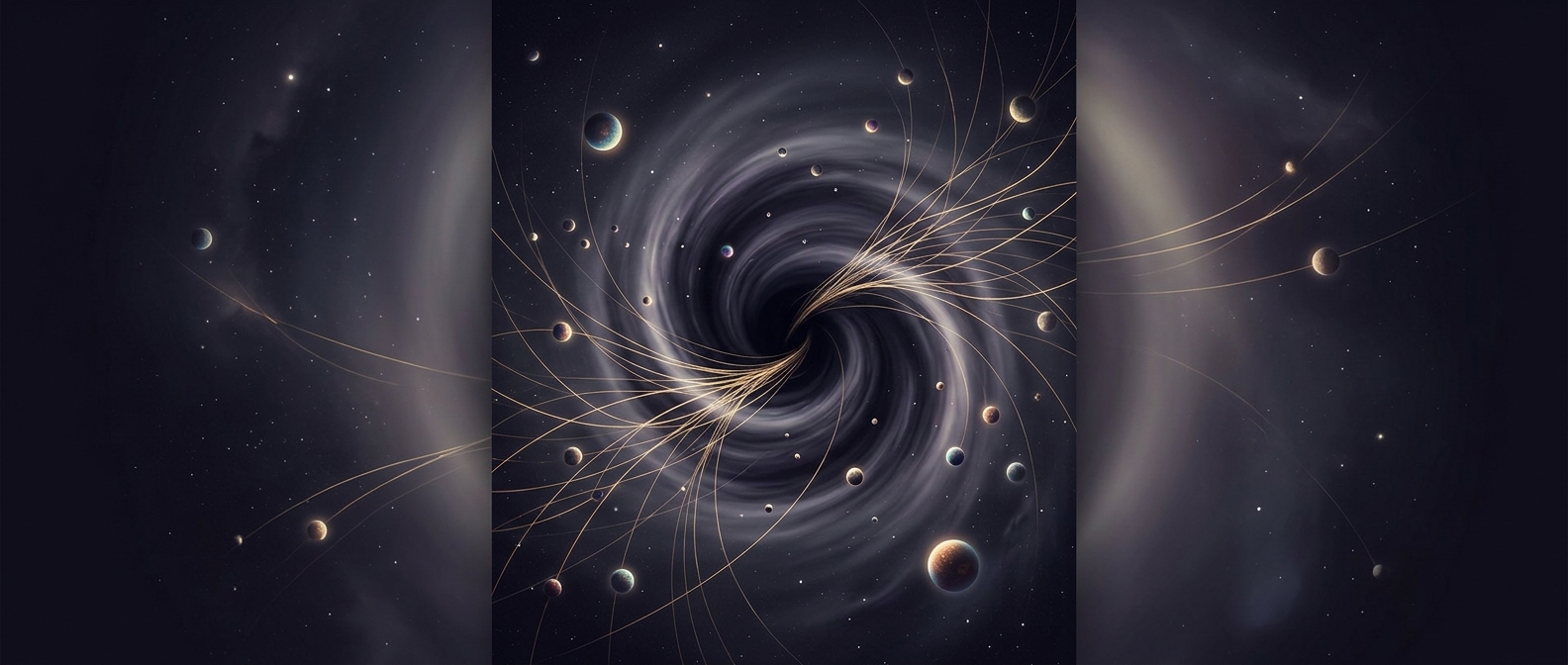
The name “Great Attractor” refers to an area of unusually concentrated mass whose gravity affects the motion of galaxies, including the Milky Way. It is not a giant body reaching across space like a magnet. The mass is spread among galaxies and galaxy clusters, along with dark matter—the unseen matter inferred from its gravitational effects.
How Astronomers Detect the Tug
Galaxies are carried apart by the expansion of the universe, but gravity can add motion on top of that general expansion. By comparing how fast nearby galaxies are moving with how fast they would be expected to recede as space expands, astronomers can identify large-scale flows toward regions with extra mass. The Great Attractor is one such gravitational influence.
The view is difficult to map directly: the relevant part of the sky lies behind the crowded plane of our own Milky Way, where its stars and dust obscure many more distant galaxies. Astronomers therefore piece together the region’s structure from observations across different wavelengths and from the motions of galaxies around us.
A Tug Within a Larger Landscape
The flow does not mean that galaxies are falling toward a single destination or that the universe is collapsing. It is a local deviation in the motion of galaxies, shaped by the uneven distribution of matter across a vast region. Other concentrations of mass also contribute, so the observed motion cannot be credited to one isolated source.
The striking implication is that the universe’s largest structures are mapped not only by what telescopes can see, but also by the subtle changes in how galaxies move.