How the Sky Became a Musical Scale
For the Pythagorean tradition, music offered a way to recognize order in the world. A plucked string sounds harmonious when its length stands in a simple ratio to another string’s: the ratio 2:1, for example, produces an octave. The striking idea was that the same kind of mathematical order might govern the heavens.
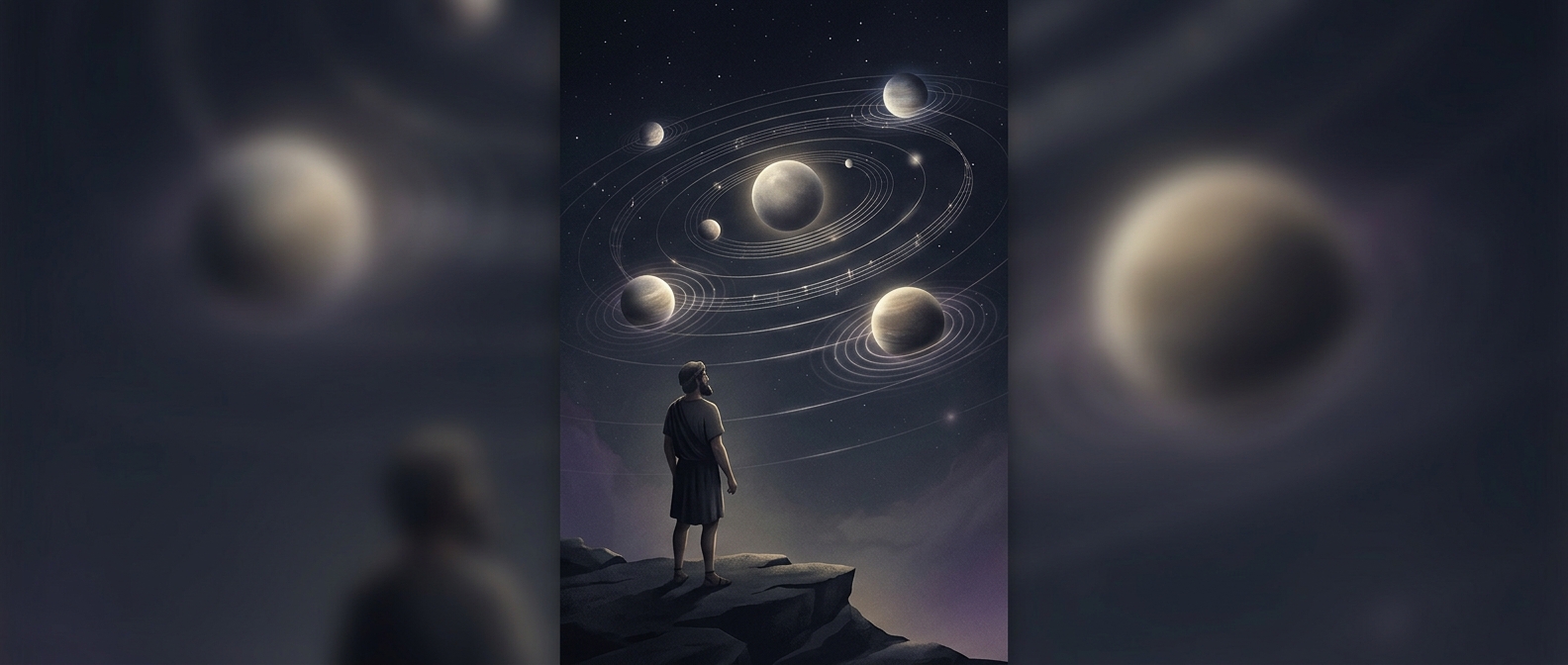
If planets followed regular paths, their movements could be understood as parts of a grand pattern of proportions. In this picture, each moving body contributed a tone, and the arrangement of tones formed a cosmic harmony. The “music” was not meant as a tune people could listen for on Earth; it was an imagined consequence of celestial motion and mathematical order.
A Harmony Heard Through Reason
The idea reflects an ancient way of joining mathematics, music, and nature. Rather than treating the planets as isolated objects, it made the sky resemble a vast instrument whose parts belonged to one system. Musical ratios gave that system an intelligible form: harmony was something that could be grasped through numbers even when it could not be heard.
The tradition is associated with Pythagoras, though accounts of his teachings were recorded later and do not let us confidently assign every version of the idea to him personally. Its lasting appeal lies in the connection it proposed: the same simple proportions that make strings sound consonant might also make the cosmos coherent. The planets’ “music” was a metaphorical sound—and a claim that the universe itself could be understood as a kind of mathematical composition.