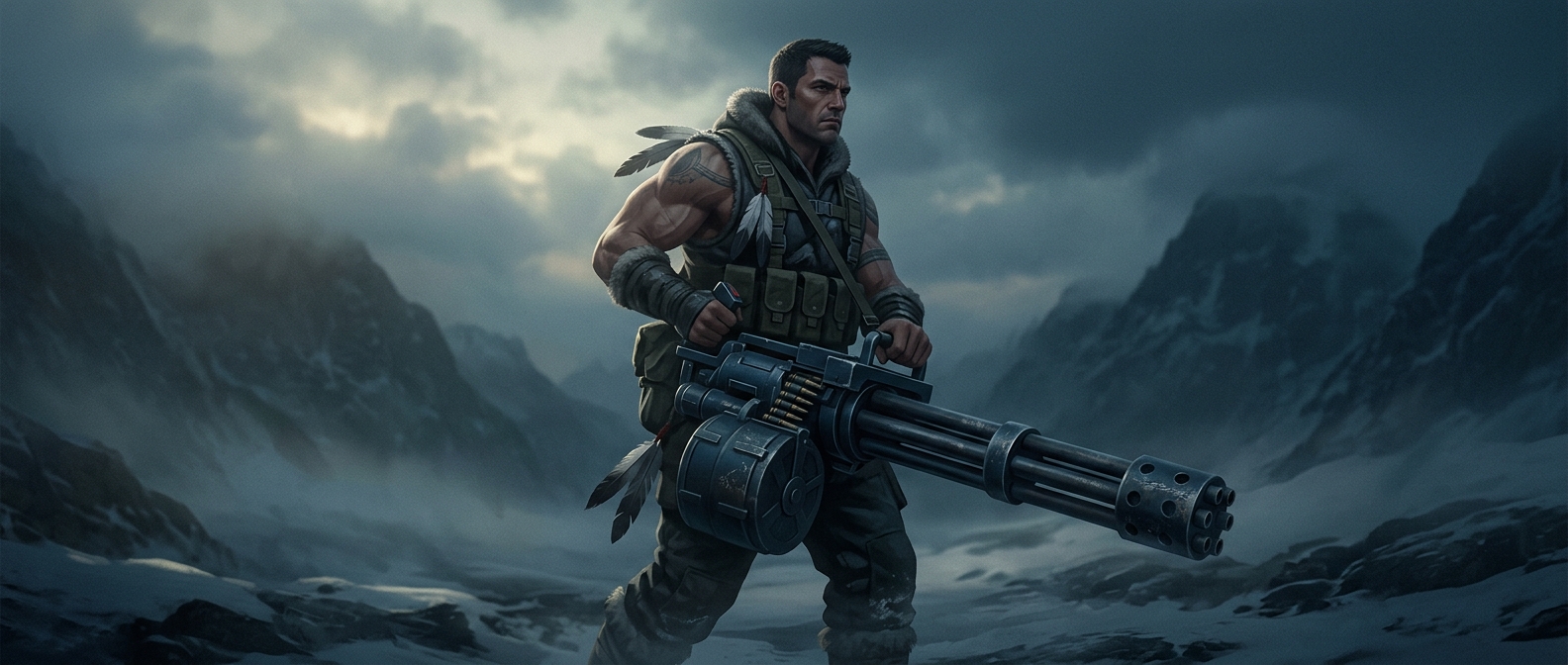
An aircraft cannon becomes a character’s signature
An F-16’s cannon is not an oversized rifle. It is a 20-millimeter rotary cannon: several barrels turn in sequence so the weapon can fire rapidly without asking one barrel to handle every shot. On the aircraft, the cannon is built into a system with structural support, ammunition storage, and power to drive its rotating mechanism.
Remove it from that system and the problem is more than finding a soldier strong enough to lift it. The cannon and its ammunition are bulky, and the force of firing would be difficult to control without the aircraft’s mounting. The game’s image deliberately collapses all that machinery into one instantly readable idea: a person wielding firepower meant for a jet.
Why make the impossible weapon handheld?
Games often communicate a character’s role before the player learns a backstory. A fighter jet’s cannon does that at a glance: this is a combatant defined by overwhelming force, not by a conventional rifle. Its impossible scale also turns a technical object into a piece of visual spectacle. The player does not need to know how an aircraft feeds or stabilizes the cannon; the silhouette alone delivers the joke and the threat.
That choice trades realism for clarity. The weapon’s real design depends on being part of an aircraft, but the game’s design depends on a player being able to recognize it immediately. The result is a compact character statement: the soldier has taken a machine built into a fighter and made it their personal weapon.