How lightning makes a planetary-scale resonance
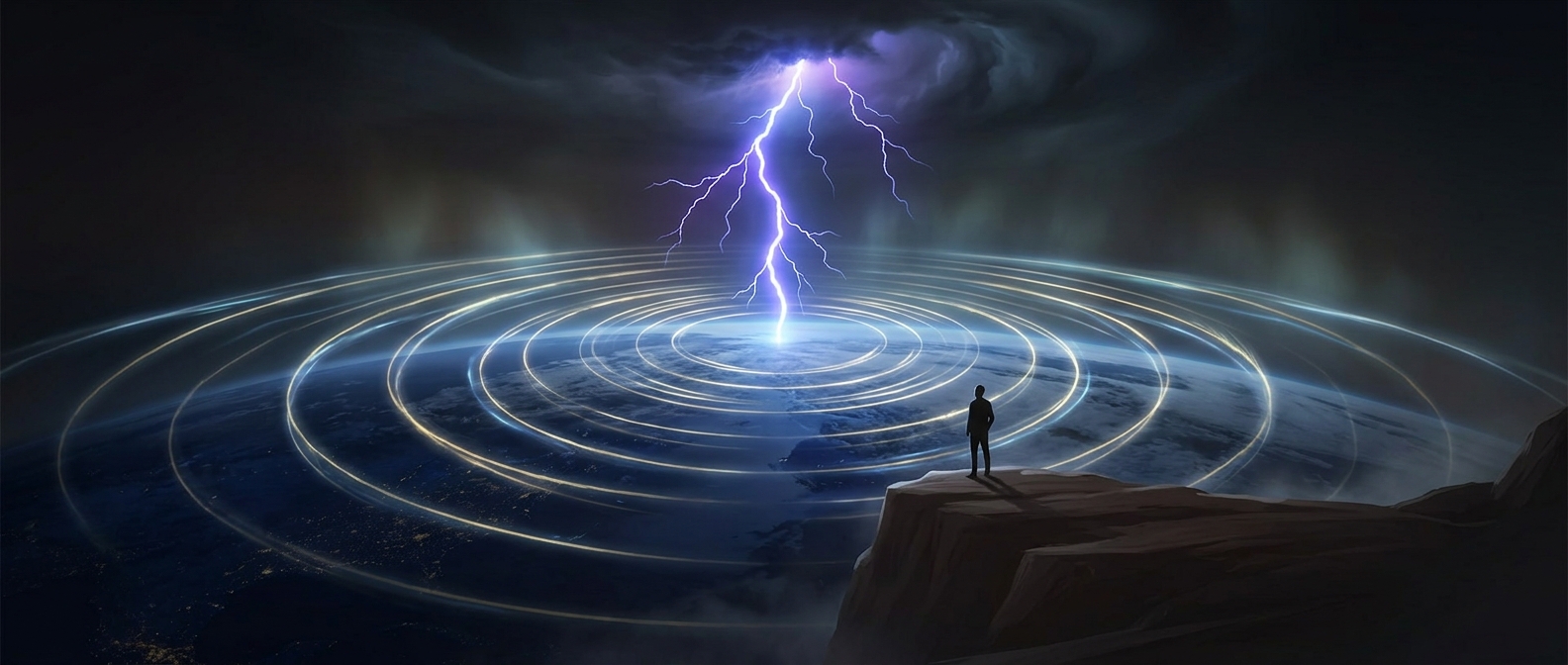
A lightning bolt is a brief, powerful electrical pulse. It sends electromagnetic waves—energy traveling as changing electric and magnetic fields—out through the atmosphere. Some of that energy becomes trapped in the space between Earth’s surface and the ionosphere, an electrically charged region high above the ground.
The waves can travel around the planet within this shell. When a wave’s path fits the cavity’s dimensions, it reinforces itself, much as a note can build inside a resonant musical instrument. The result is a set of favored frequencies called Schumann resonances. The strongest is near 7.83 hertz, meaning roughly eight oscillations per second.
A resonance, not a steady planetary tone
Lightning does not produce one neat 7.83-hertz signal. Each strike releases energy across a range of frequencies; the Earth–ionosphere cavity strengthens certain patterns and leaves detectable peaks. Because the cavity’s upper boundary changes with conditions in the ionosphere, the resonances are not perfectly fixed or uniform.
The signal is real and can be measured with sensitive instruments, but it is faint amid other natural and human-made electromagnetic activity. It is not a sound in the air, either: 7.83 hertz is far below the range of human hearing.
That distinction explains why the resonance can inspire talk of a “planetary hum” without being a hidden soundtrack. Its frequency describes an electromagnetic pattern sustained by a lightning-lit cavity—not a proven biological signal or evidence that the planet is sending messages.