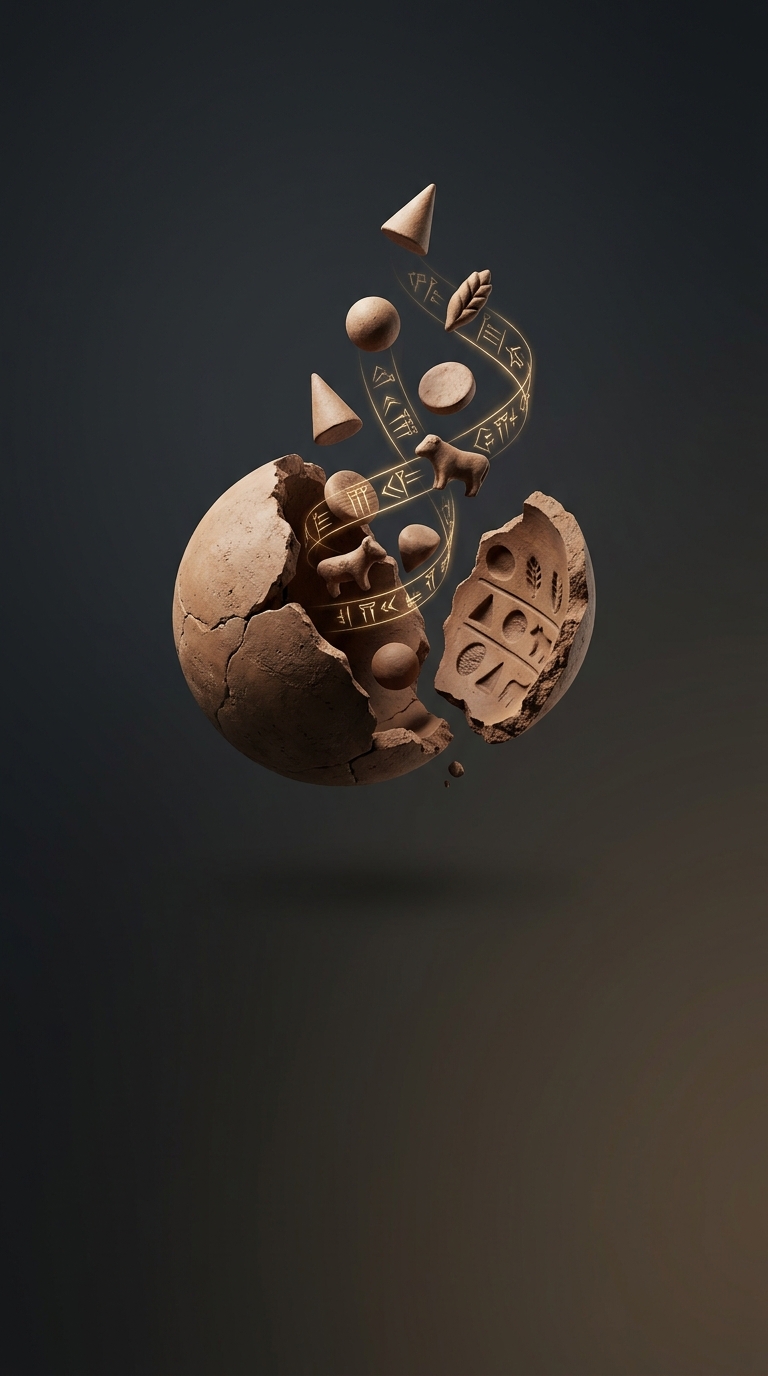
How Clay Counters Made Trade Accountable
A token turned an abstract claim—such as “this much grain is owed”—into something people could handle and count. Different shapes represented different goods or quantities, so a merchant or storekeeper could check a delivery against a physical set of counters rather than rely on memory alone. The tokens were not money in the later sense: they did not necessarily circulate as a general means of payment. They were tools for keeping track of what was stored, delivered, or owed.
Sealing a Count Against Dispute
For a transaction that needed a record, the counters could be placed inside a hollow clay envelope, or bulla. While the clay was still soft, the parties could press tokens against its surface, leaving marks that indicated what was inside. A seal pressed into the clay could also help identify who had secured the record. Once dried, the bulla could be carried or stored without its contents being changed unnoticed.
That mattered when goods moved between people or places. If someone challenged a shipment’s count, the sealed envelope offered a check against the claim: break it open, count the tokens, and compare them with the impressions. The system did not eliminate disagreement, but it made the terms of a transaction less dependent on one person’s memory or word.
From Local Counting to Durable Records
As farming communities managed harvests, storage, and exchanges, even a simple tally could connect a delivery today with an obligation to be settled later. Clay was easy to shape and, once hardened, difficult to alter without leaving evidence. That combination made it useful for records that had to survive beyond the moment of exchange.
The striking shift was from a spoken promise to a count that could travel: a claim about goods became an object other people could inspect, challenge, and verify.