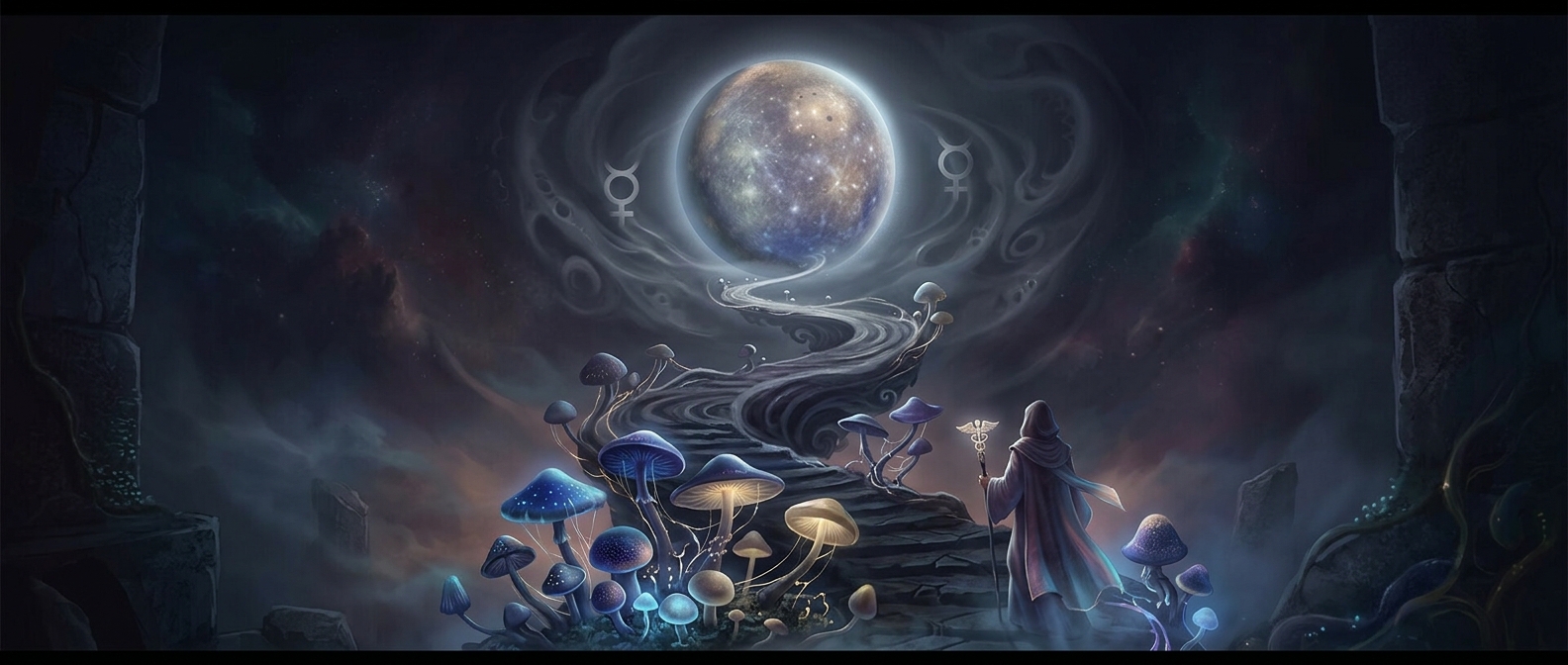
Why astrology places mushrooms under Mercury
In astrological symbolism, assigning a plant or natural object to a planet is a way of describing its perceived character, not a claim about what causes it to grow. Mushrooms are linked with Mercury because their sudden appearance and preference for dim, in-between places fit qualities traditionally associated with that planet: quickness, movement, and life at boundaries.
A brief appearance in a hidden place
A mushroom can seem to materialize overnight. Much of the fungus, however, lives out of sight as a network of fine threads in soil or wood; the visible mushroom is its short-lived reproductive structure, releasing spores that can spread and begin new growth. That contrast—hidden activity followed by a rapid, conspicuous emergence—gives the symbolism a concrete hook.
The setting matters, too. Forest shade is neither open sunlight nor complete darkness, and a mushroom often appears where one kind of material is breaking down into another. Such thresholds echo Mercury’s symbolic role as a traveler or intermediary, moving between places and states.
A symbolic fit, not a botanical rule
Calling mushrooms “Mercurial” is therefore a reading of their appearance and habitat through astrological associations. It does not mean fungi are scientifically governed by Mercury, or that every astrological tradition classifies them identically. The memorable idea is the match between a hidden organism and a fruiting body that can suddenly cross into view—an apt emblem for a planet associated with passage and change.