Why Earth Once Seemed Like the Center
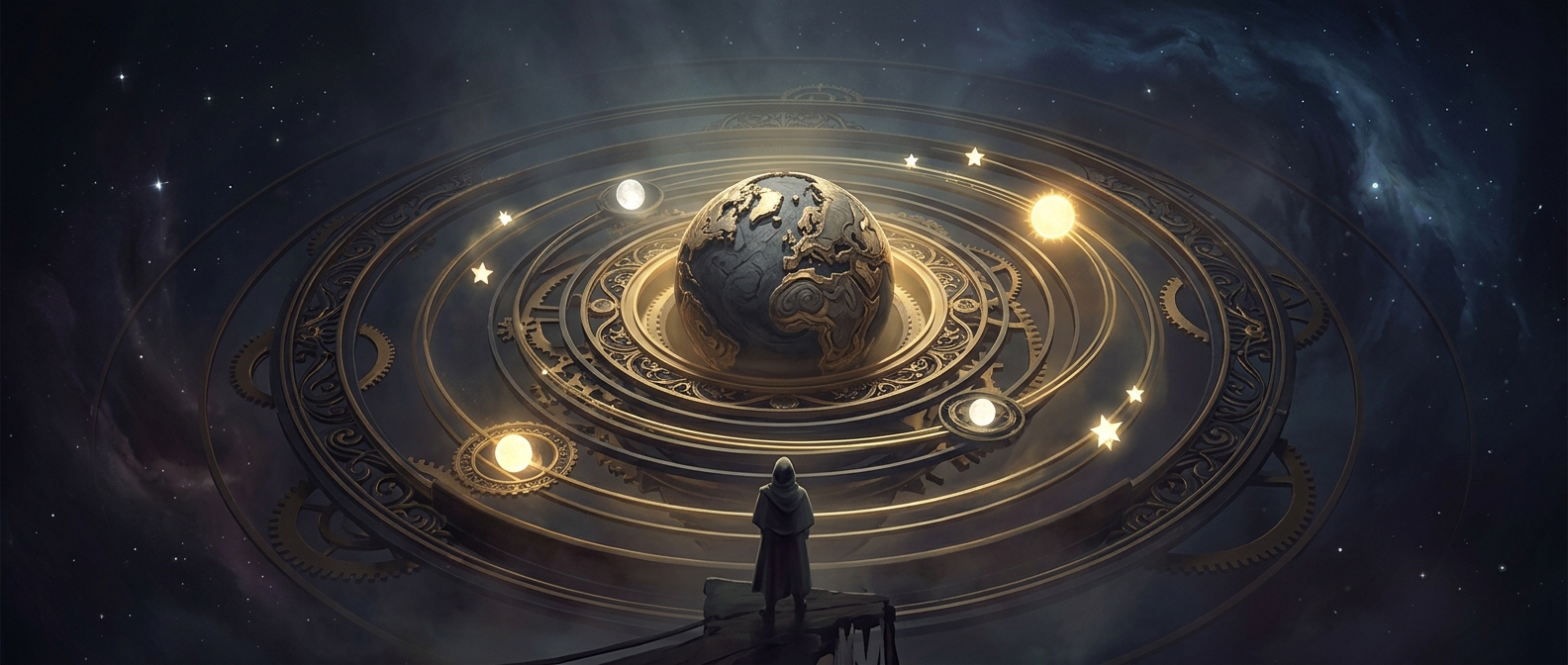
From the ground, the sky appears to turn around us. The Sun rises in the east and sets in the west, while stars trace arcs overhead. A geocentric model—one that places Earth at the center of the cosmos—offered a way to organize those familiar observations. It was not simply a claim that people were personally important; it was a picture of the universe built from what the sky seemed to do.
The model also had to account for planets, whose positions shift against the background stars. Sometimes a planet appears to slow, reverse direction, and then resume its usual path, a motion called retrograde motion. Ancient astronomers used nested circular paths, or epicycles, to represent those apparent loops while keeping Earth central.
A Cosmic Center—and a Human Joke
That arrangement could describe many observations, but it grew complicated as astronomers tried to make its predictions more precise. The later shift toward a Sun-centered model changed the explanation: Earth itself moves, and the apparent backward loop occurs when Earth passes another planet in its orbit.
The joke in a modern geocentric view comes from a different kind of “center.” The old model places the planet Earth at the middle of the cosmos; the joke makes it sound as though the universe is arranged around whichever person happens to be talking. A claim about where Earth sits becomes a quip about how easily we mistake our own viewpoint for the whole picture.