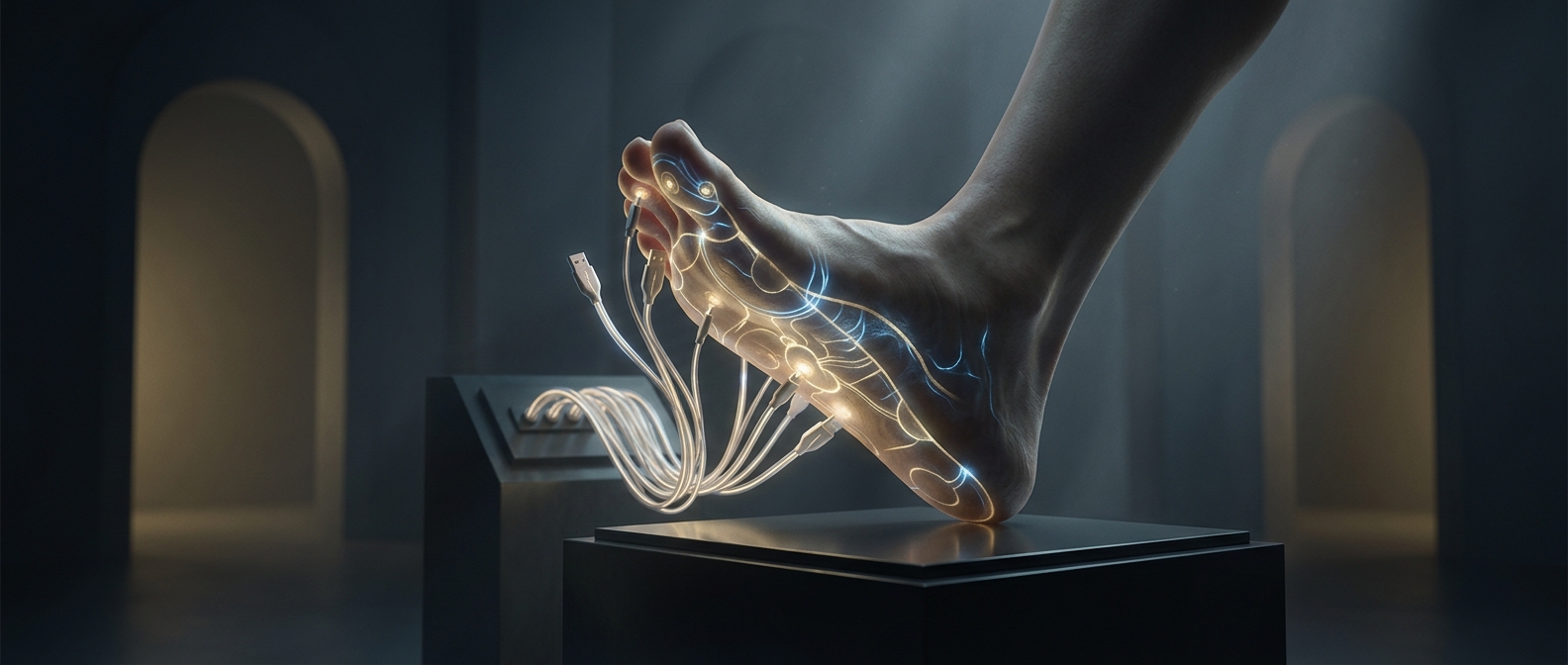
A map drawn onto the sole
Reflexology starts with a map: practitioners divide the feet into zones they associate with parts of the body. In many charts, the toes correspond to the head and neck, while areas farther down the sole are linked to the chest or abdomen. A session uses thumb or finger pressure on these spots, often moving through several zones rather than simply massaging wherever a foot feels sore.
The map is the practice’s central idea—not a set of anatomical connections. Ordinary nerves carry signals between the feet and brain, but there is no established pathway by which pressing a particular patch of skin selectively treats the organ assigned to it. The diagrams are best understood as a framework reflexologists use to organize touch and interpret sensations, not as a second, hidden wiring system.
Why a foot treatment can still feel significant
Focused pressure can be soothing, and the attention, quiet, and human contact of a session may make it feel restorative. That experience can be real without showing that a specific organ has been reached through the foot. Reflexology’s appeal lies partly in how tangible its map is: a person can point to a small spot and connect it to a much larger part of the body.
That distinction matters when symptoms suggest illness. A comforting session may sit alongside ordinary care, but the map cannot identify or repair a diseased gallbladder. The foot can offer a place to feel cared for; it is not a remote control for the organs.