The same notes can do different jobs
An arpeggio plays the notes of a chord one after another instead of all at once. It is a useful way to make harmony feel active: a rising or falling pattern can build momentum even when the underlying chord stays the same. Counterpoint—two or more distinct melodic lines sounding together—adds another layer, as each line moves against the others. Both techniques can make a passage feel intricate without relying on a simple block of chords.
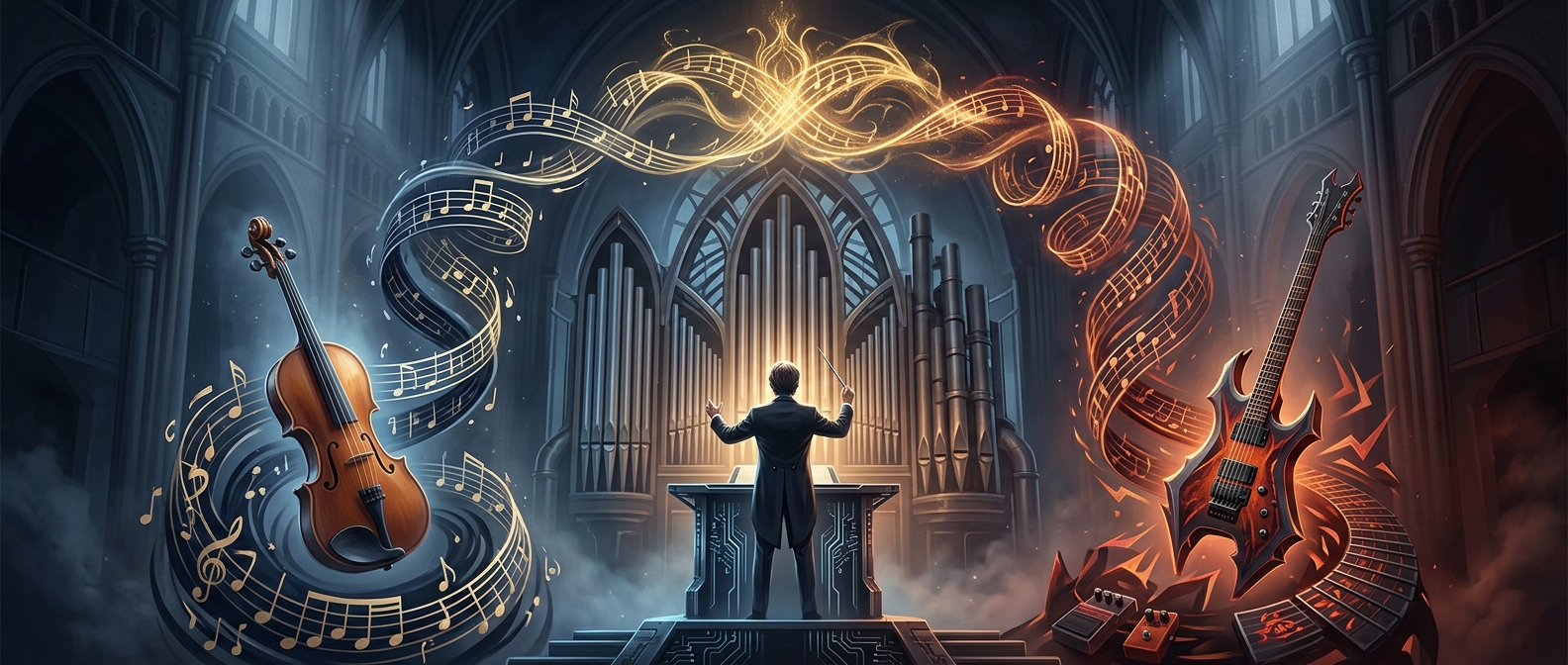
Those ideas are not exclusive to classical music, and a metal passage that uses them is not necessarily quoting Mozart. But the resemblance can be striking because both traditions can put elaborate, tightly organized note patterns at the center of a dramatic piece.
The guitar changes the effect
On a guitar, a player can race through an arpeggio, repeat it at high volume, or push its notes into a dense, sustained sound with distortion. Distortion adds overtones—extra pitches that blend with the note being played—so a clean, precise pattern can become rough-edged and imposing. A second guitar can answer or overlap with the first, creating the interlocking lines of counterpoint while drums and bass supply a heavier pulse.
Harmony also shapes the mood. A shift to an unexpected chord, or a progression that delays a satisfying resolution, can make music feel tense and then release that tension. Metal can use that same sense of arrival associated with classical drama, but amplify it through volume, distortion, and forceful rhythm. The family resemblance lies in the musical construction; the guitars change its weight and texture.