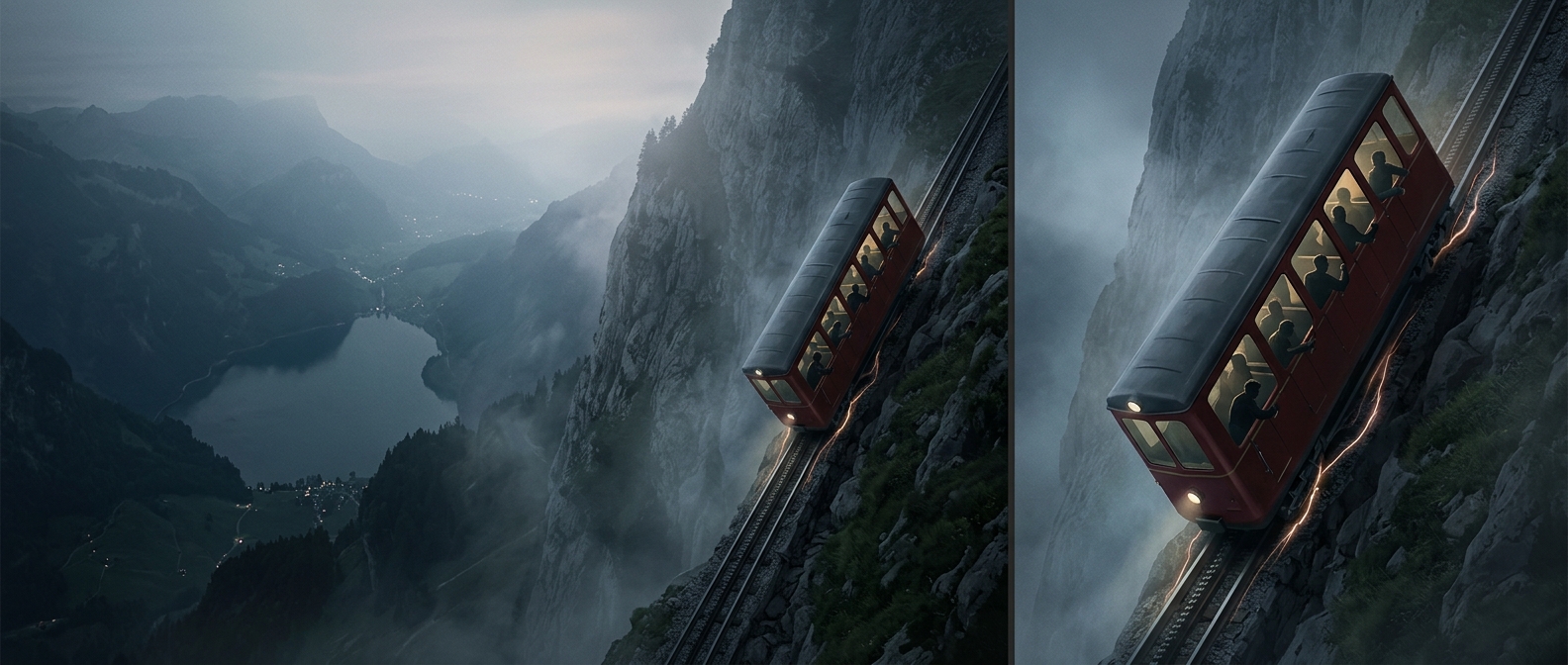
How the Pilatus Railway grips a mountainside
The railway up Mount Pilatus is not held to the slope by ordinary wheel friction alone. Its steepest section reaches a 48 percent gradient—a rise of 48 units for every 100 units of horizontal distance, or about 26 degrees. The “48 degrees” sometimes used to describe it overstates the angle; the striking figure is the grade.
When the line opened in 1889, its engineers had to solve two problems at once: give the train enough traction to climb, and keep its driving mechanism securely engaged with the track on a slope where gravity constantly pulls the train downhill.
A rack that grips from both sides
The solution is a rack railway. Between the running rails sits a toothed metal bar, and gears under the train mesh with its teeth. Instead of relying on smooth wheels to push against the rails, the train climbs by turning those gears against the rack.
Pilatus uses the Locher system, devised for this unusually steep route. Its rack has teeth on both sides, engaged by horizontal cogwheels beneath the train. The opposing gears help prevent the drive from lifting or slipping out of engagement under the pull of gravity—a key limitation of rack arrangements that grip from only one side at such an incline.
The rails still guide and support the train; the rack supplies the climbing force. This division of labor lets the railway follow a slope that would defeat an ordinary adhesion railway, while the toothed connection also gives the train a controlled way to resist the downhill pull.
Why the engineering matters
The mountain’s steepness dictated the railway’s unusual hardware, rather than merely making the ride dramatic. The result is a train whose wheels do not have to find enough friction to conquer the slope: its gears stay mechanically locked into a track designed for the climb.