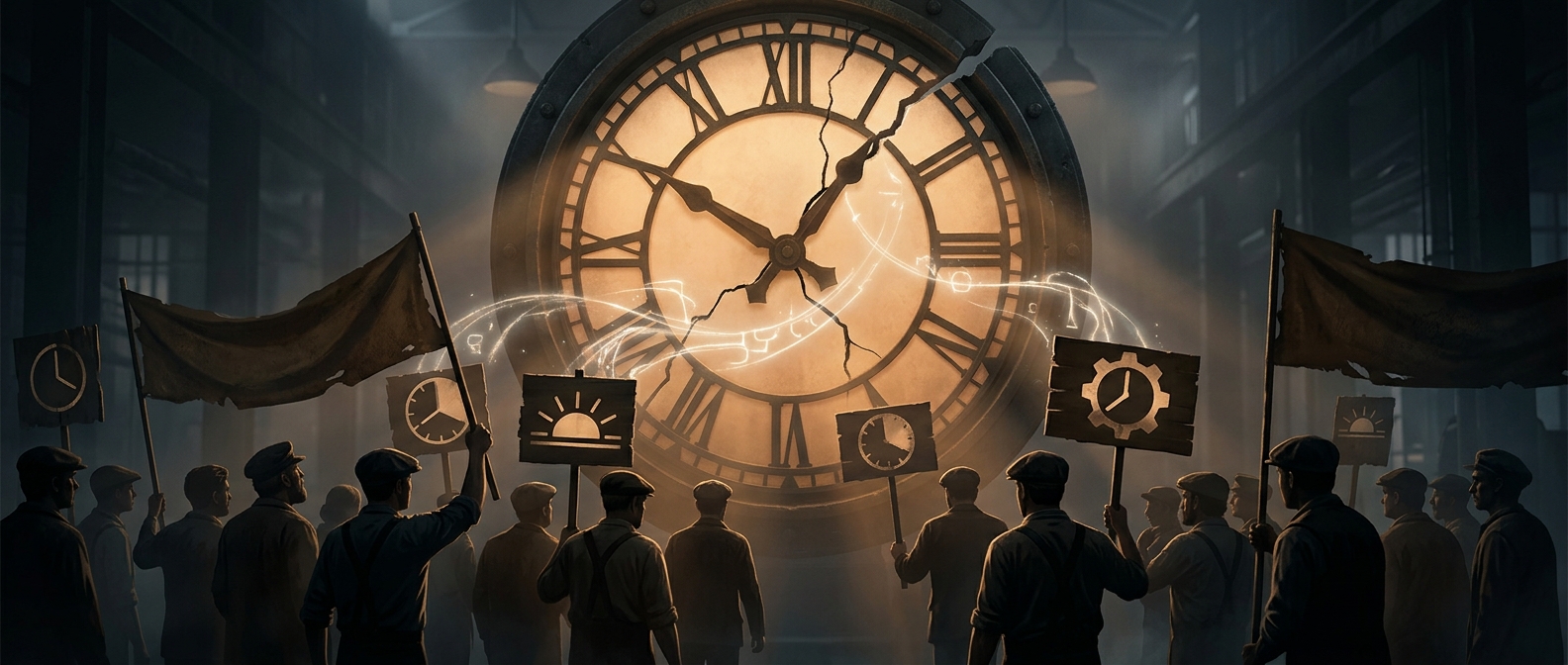
Why a shorter day threatened the factory system
In early industrial workplaces, employers organized production around machinery, synchronized shifts, and long stretches of continuous operation. A shorter day therefore looked like more than a change to the clock: it could mean paying for additional workers to cover the hours, rearranging shifts, or accepting less time to earn back the cost of equipment and buildings. Employers who judged output by hours on the job often treated any limit as a threat to production.
Workers saw the same calculation from the other side. When a job consumed most of the waking day, there was little time left for sleep, family, education, or civic life. The campaign for an eight-hour day challenged the assumption that industrial growth entitled an employer to nearly all of a worker’s usable time.
The bargain was about control, not just hours
The demand made working time legible and negotiable. Instead of leaving the length of a shift to each employer’s discretion, workers could organize around a shared limit. That made the eight-hour day a labor standard: a common expectation that could be pressed through collective action and, over time, incorporated into workplace rules and law.
The tradeoff did not disappear. Employers still had to decide whether to add shifts, hire more people, or seek greater output per hour; workers gained time outside the job, but the result depended on whether the limit was actually enforced. What made the demand radical was its claim that a worker’s day should have a boundary—and that the hours beyond it belonged to a life, not automatically to a business.