Why Hermetic writings make room for paradox
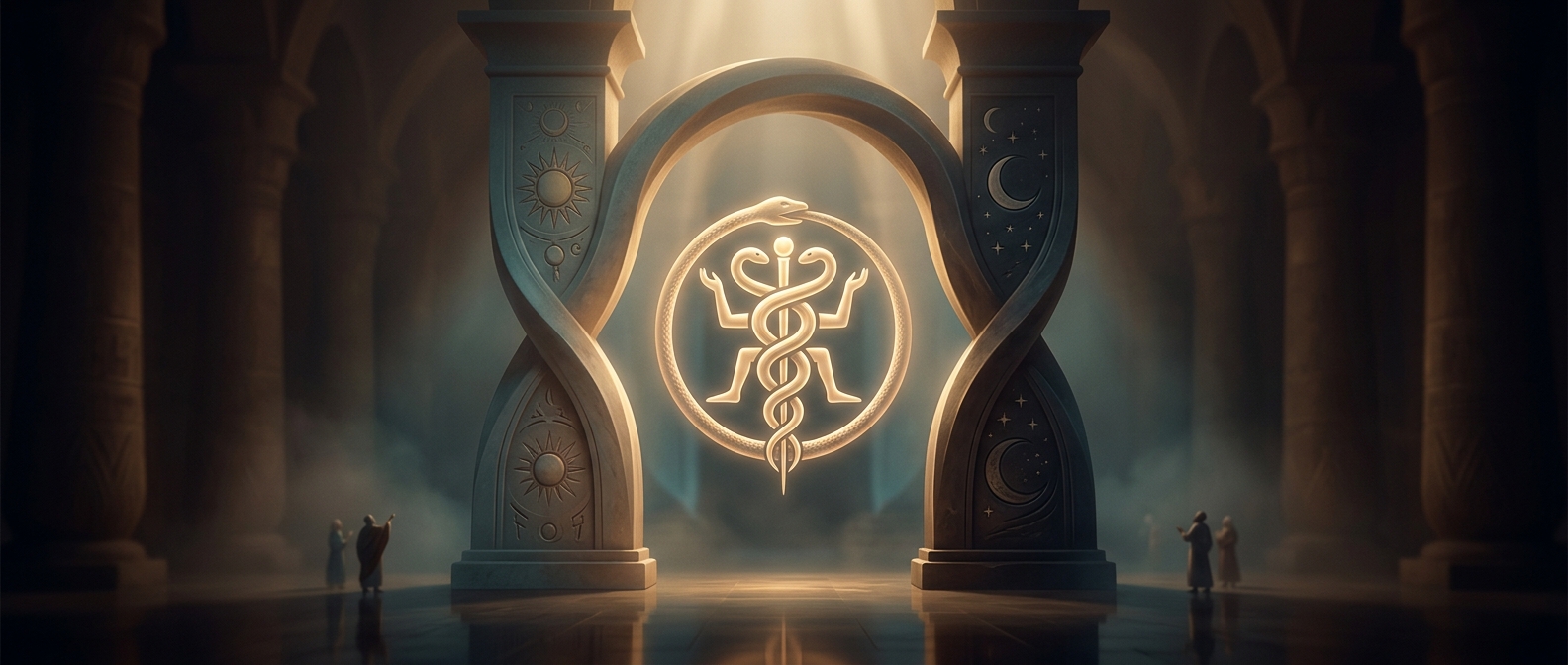
Hermetic literature is a collection of religious and philosophical writings from the ancient Mediterranean world, traditionally associated with Hermes Trismegistus. Its authors explore questions such as what the divine is, how the cosmos is ordered, and how a person might come to know it. They often describe reality through paired ideas—light and darkness, life and death, the visible and invisible—without treating one side as the whole story.
That style can make a passage feel self-contradictory. But the tension often points to the limits of ordinary categories: a divine source, for example, may be described as present throughout the world yet greater than the world. The language asks readers to hold both claims in view instead of reducing the subject to a simple either-or.
A challenge to habitual thinking
In this setting, paradox is a teaching device. A puzzling claim interrupts the reader’s urge to sort everything into familiar boxes and invites a different kind of attention. The goal is not necessarily to solve a riddle with one tidy formula; it may be to reconsider what the words “inside,” “outside,” or “one” can mean when applied to the divine.
This does not mean every inconsistency should be treated as profound or that Hermetic texts offer one uniform doctrine. The writings vary, and their language can be difficult. Their recurring use of opposites, however, gives readers a practical clue: when a statement seems to pull in two directions, the tension itself may be part of the argument. Instead of choosing a side at once, the reader is asked to examine why both descriptions might matter.