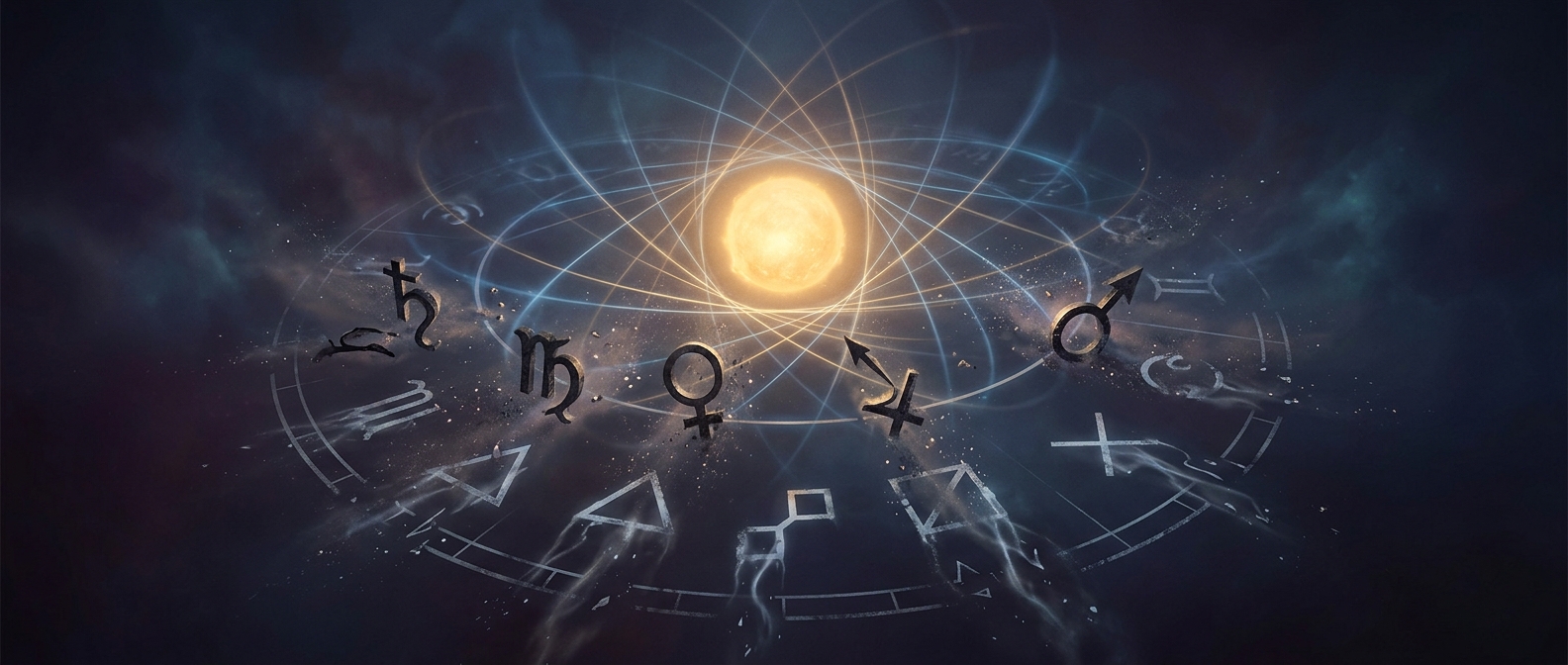
How “As Above, So Below” Became a Hermetic Idea
Hermeticism takes its name from Hermes Trismegistus, a legendary teacher formed by blending features of the Greek Hermes and the Egyptian Thoth. The writings attributed to him were composed in the ancient world, largely in Greek, rather than preserved teachings from one identifiable historical sage. They imagine the universe as an ordered, intelligible whole—and human beings as capable of understanding something of that order.
The familiar phrase “as above, so below” is associated especially with the Emerald Tablet, a short text that circulated in medieval translations and became influential in later European alchemy. Its wording varies across translations. The phrase is a compact expression of correspondence: patterns found in the greater world may offer clues to patterns in the smaller one.
A Principle of Correspondence, Not a Simple Cause
“Above” and “below” can mean the heavens and Earth, the cosmos and the human body, or spiritual and material levels of reality. The point is not necessarily that every event in the sky mechanically causes a matching event in a person’s life. Rather, the different levels are treated as related parts of a connected whole, so that studying one might illuminate another.
That way of thinking helped give several practices a shared intellectual frame. Astrology looked for meaningful relationships between celestial patterns and earthly life; alchemy explored transformations of matter, often alongside questions about spiritual change; theurgy used ritual practices intended to engage with divine powers. These were distinct pursuits, not simply interchangeable versions of one doctrine.
Why the Slogan Still Travels
The phrase endured partly because it compresses a demanding worldview into a memorable image. For a historical alchemist, correspondence could be a guide to investigating nature; for a modern reader, it may work more as a metaphor for connections between inner life and the wider world. Those uses are not identical. The old maxim is a statement of a philosophical outlook, not evidence that a planetary position explains a particular choice—such as sending a late-night text.