Why rhubarb fit Saturn’s stern reputation
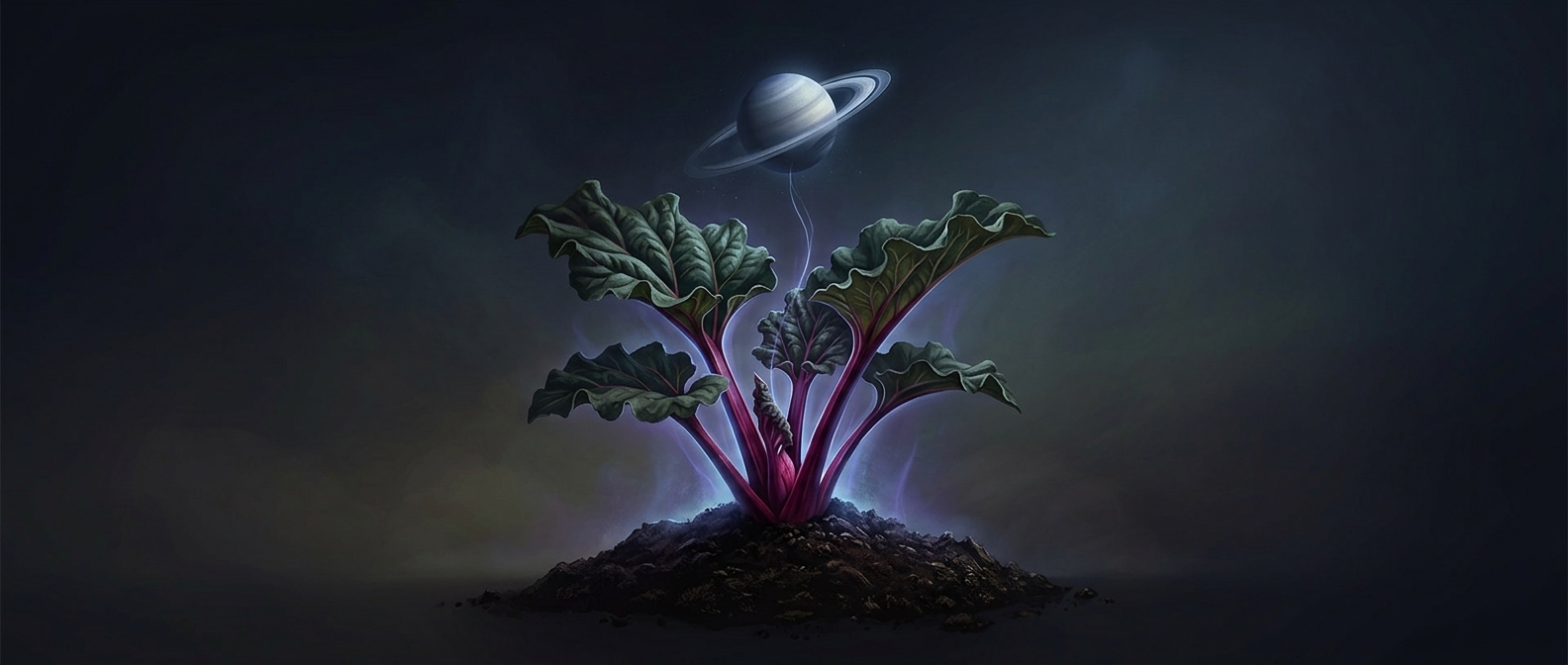
Astrological herb lore treated plants as more than ingredients: their taste, appearance, growing habits, and effects were read as signs of a connection to a planet. Saturn, in this symbolic system, stood for restraint, difficulty, age, and things that demanded patience. Rhubarb’s sharp taste and the effort required to turn its stalks into a pleasant dish made it an apt emblem of Saturnian austerity.
From a planetary quality to a kitchen task
The correspondence works by analogy, not by a claim that Saturn causes rhubarb to taste tart. The plant’s harshness seemed to echo the planet’s stern character, while the cook’s work supplied a small, everyday enactment of that character: the stalks needed preparation and enough sweetness to soften their edge. In this way, an ordinary food could carry a moral or astrological association into the kitchen.
Such correspondences belonged to a broader habit of organizing nature through resemblance. A plant might be linked to a planet because of how it looked, tasted, grew, or was used. The point was not a modern botanical classification, but a way of making the natural world feel patterned and meaningful.
The symbolism in a spoonful
Rhubarb’s pairing with Saturn turns a practical culinary fact into a compact lesson in traditional symbolism: difficulty and sharpness can be softened, but not without effort. The sugar does more than balance the flavor; in the lore, it helps make the planet’s sternness tangible.