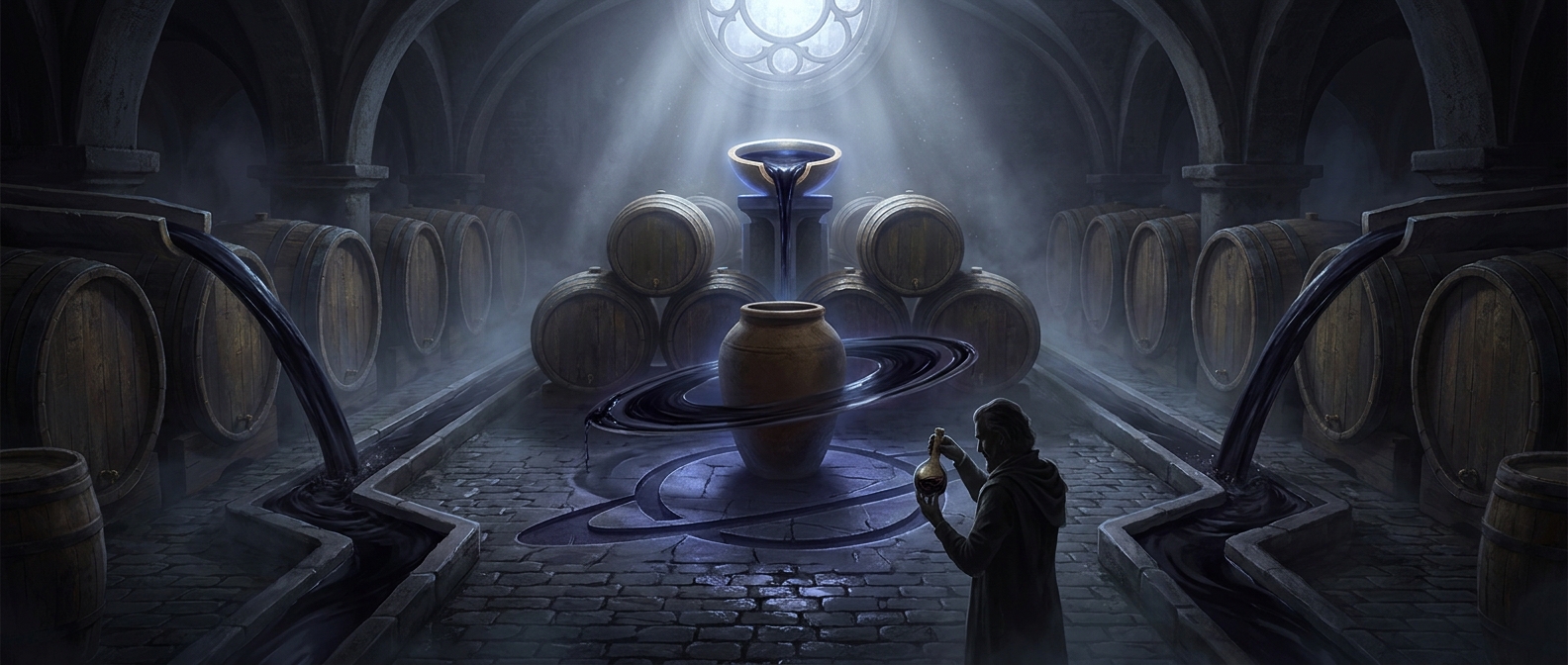
Why vinegar was linked to Saturn
In traditional astrological symbolism, vinegar’s connection to Saturn is an analogy, not a claim about its physical origin. Saturn was associated with qualities such as age, severity, restraint, and endurance. Vinegar seemed to embody several of those qualities: it was sharply sour, could be made by letting a drink ferment, and helped preserve food.
Sourness, time, and restraint
Vinegar’s bite made it a natural emblem of austerity—the opposite of sweetness, richness, or immediate pleasure. Its making also involved time: microbes turn alcohol into acetic acid, the substance that gives vinegar its characteristic sharpness. Once made, vinegar could slow spoilage in some foods, helping them last beyond the season in which they were harvested.
Those practical features gave the symbolism something tangible to work with. A substance produced through transformation and used to resist decay could be read as Saturnian: associated with age, limits, and persistence. The correspondence belongs to a system of symbolic interpretation, not to modern chemistry or astronomy.
A symbolic classification, not a recipe
Assigning a food to a planet helped astrologers and related traditions organize the natural world through perceived likenesses. The label did not mean that Saturn made vinegar sour or that vinegar had a proven planetary effect. It meant that, within this symbolic vocabulary, vinegar’s severity and preserving power made it resemble Saturn.
The association turns an everyday condiment into a compact image: sharp enough to deny sweetness, yet useful for making what is old endure.