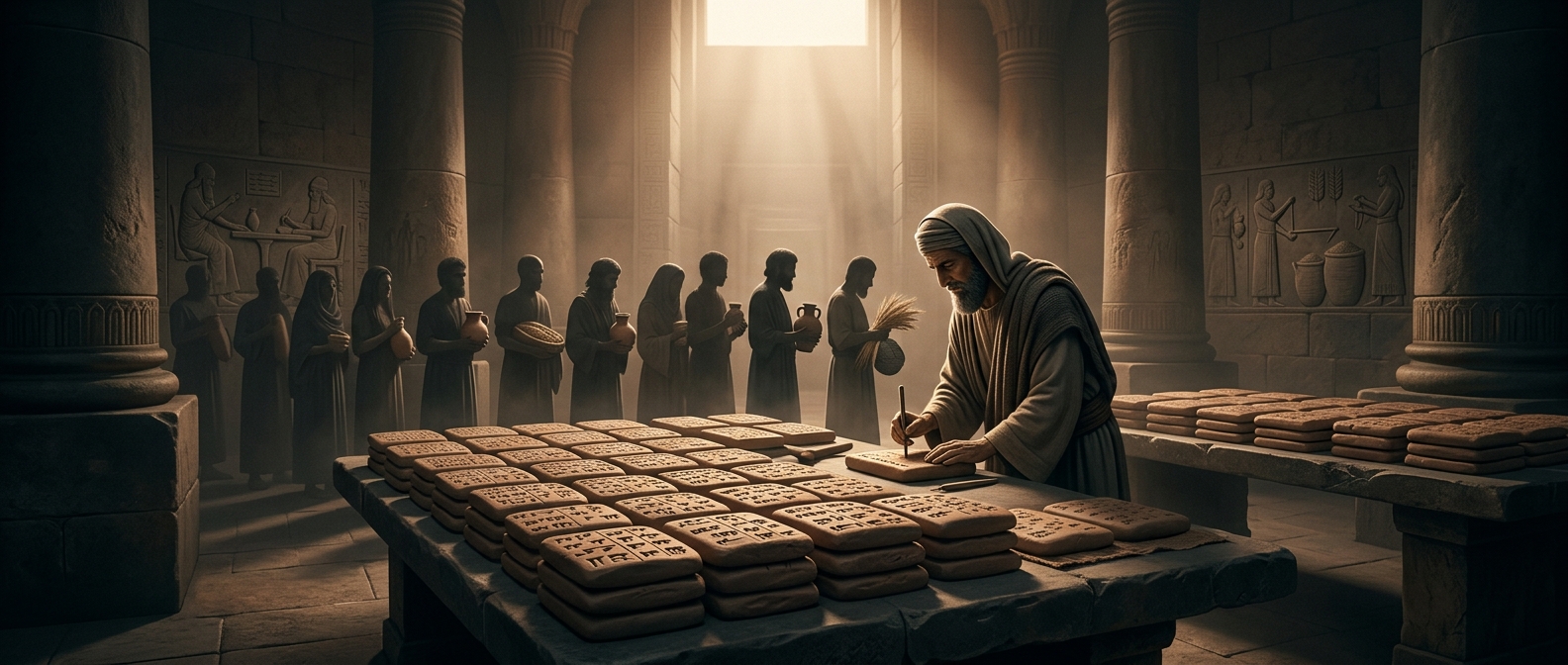
Clay made administration visible
In southern Mesopotamia, where early cities depended on farming and organized labor, officials had a practical problem: harvests and supplies had to be collected, stored, and distributed among many people. A spoken agreement could be forgotten or disputed. A mark on clay could remain after the conversation ended.
By the late fourth millennium BCE, people were pressing signs into small clay tablets to record goods and quantities. A reed stylus could make a wedge-shaped impression, while simpler marks represented numbers or commodities. Many of the earliest surviving tablets are administrative records—lists of items such as grain, livestock, or labor—not stories written for entertainment.
Counting pushed signs toward writing
A record had to do more than show that something existed. It needed to distinguish, for example, a quantity of grain from a quantity of animals. As scribes combined number signs with signs for goods and other information, the system could preserve increasingly specific transactions. Clay was useful because it was plentiful, easy to mark while damp, and durable once dried or fired.
These records were not necessarily a direct account of a modern tax system. They reflect institutions managing resources, including goods received and goods issued. The pressure to keep track of those movements helped turn marks used for accounting into a more flexible system of writing. Over time, scribes used signs to record language more fully, opening the way for literature as well as administration.
The striking consequence is that writing’s earliest surviving purpose was not to preserve a ruler’s speech or a poet’s song. It was to make obligations and supplies legible to an institution—so a storehouse could be managed even when the people who counted its grain were no longer in the room.