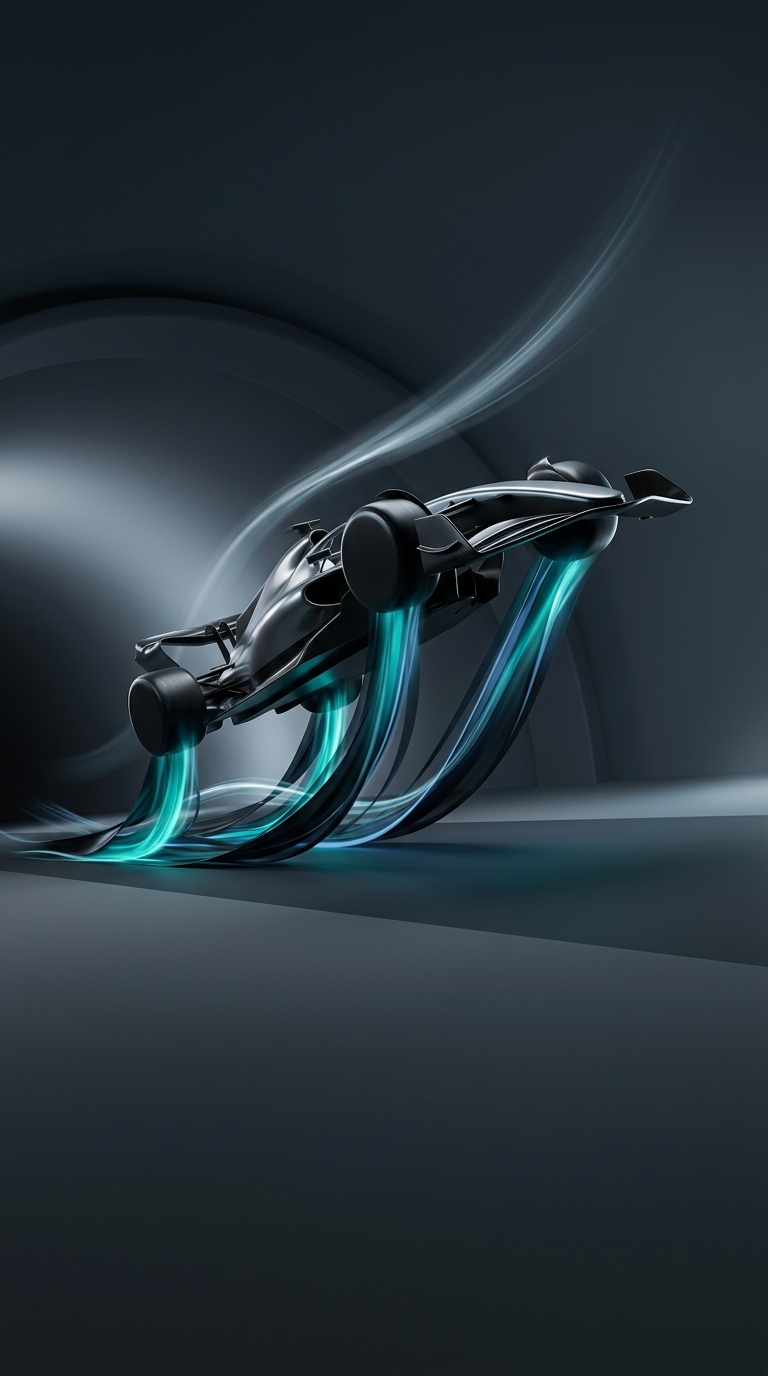
How a Race Car Can Be Pressed Toward the Ceiling
A Formula 1 car does not stick to a surface like a magnet. Its wings and carefully shaped underside redirect fast-moving air, producing downforce: an aerodynamic force that pushes the car toward the road. The faster the car travels, the more air flows around it and the stronger that force becomes—roughly increasing with the square of speed in a given setup.
The underside matters as much as the visible wings. Air is guided through narrow spaces beneath the floor, then released at the rear. This airflow helps create lower pressure under the car than above it, so the higher-pressure air presses the car downward. The wings add further downward force by deflecting air upward, which produces an opposite push on the car.
Why Speed Is the Key
Downforce presses the tires into the track, giving them more grip for cornering and braking. At low speed, a car’s weight supplies most of that tire load. At high speed, aerodynamic pressure can add a great deal more—without adding mass to the car.
That is why the upside-down tunnel idea is physically plausible in principle: if the aerodynamic force were strong enough, it could hold the car against a ceiling, with the tires supplying the contact and friction. But the thought experiment assumes a suitable tunnel, stable airflow, enough room to reach the necessary speed, and a car configured to produce the needed force. A real Formula 1 car is built to run on a circuit, not to drive on a ceiling.
The Cost of Pushing Down
Downforce is useful, but it is not free. Wings and floors also create drag—the air resistance that slows the car and costs speed on straights. Teams therefore balance grip against drag: more downward force can help through corners, while a less resistant setup can be faster where straight-line speed matters most.
The striking part is that the car’s apparent weight can change dramatically with speed. The same machine that relies on ordinary gravity in a slow corner can, in theory, generate enough aerodynamic pressure to make gravity’s direction seem like the smaller problem.