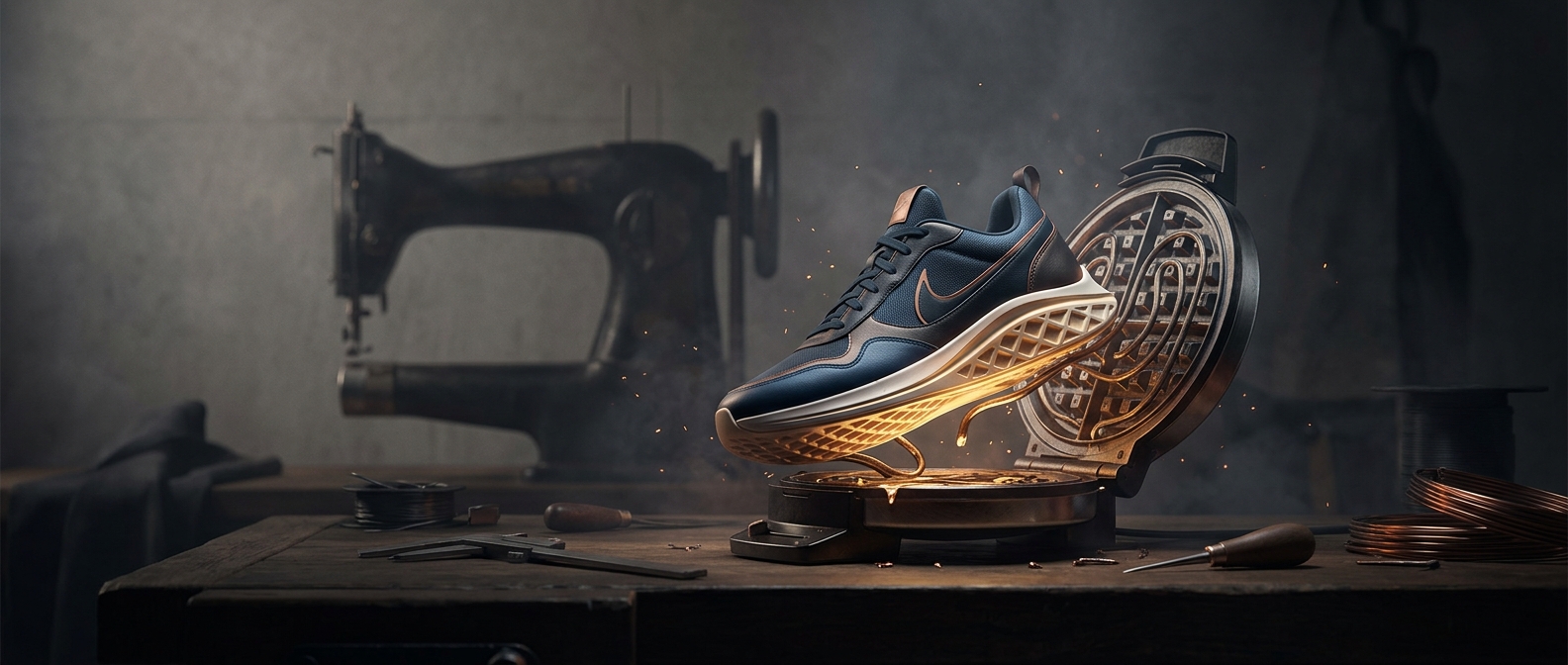
The breakfast experiment behind the waffle sole
In the early 1970s, University of Oregon track coach Bill Bowerman was looking for a better way to give runners grip without relying on heavy or track-specific spikes. A shoe’s sole had to do two jobs at once: bite into the ground, yet stay light and flexible enough for ordinary running.
Bowerman’s solution began with the grid of a household waffle iron. He poured liquid rubber into the iron, using its patterned surface as a mold. The resulting prototype had raised blocks—or lugs—on the bottom instead of a smooth sole. The experiment damaged the appliance, but it gave him a tangible way to test the idea.
Why a grid could help runners
Those small projections created edges that could press into the ground and improve traction. Because the pattern spread them across the sole, the shoe did not need a single heavy plate of material to make contact. The gaps between the lugs also helped keep the sole from becoming one solid, stiff slab.
The waffle pattern was not magic, and its performance depended on the surface and the shoe built around it. Its importance was that it offered a practical design compromise: grip distributed across a lightweight running shoe, rather than traction confined to track spikes.
Bowerman developed the concept into a running-shoe design that helped shape Nike’s early footwear. The memorable part is not just that a kitchen appliance became a mold; it is that an everyday grid suggested a new way to balance traction and weight. The ruined waffle iron was an early cost of testing that idea in rubber.