How Mario’s Design Made Each Pixel Count
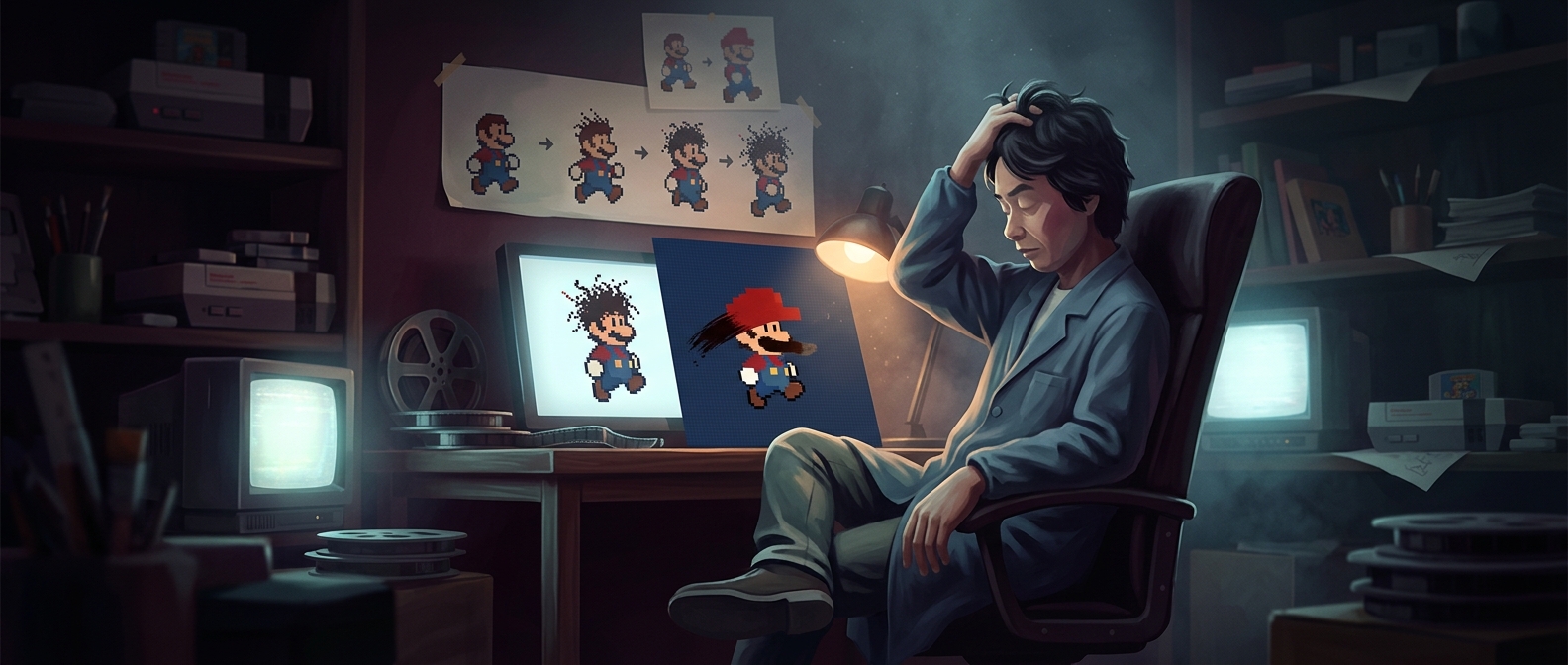
A game character on a small pixel grid has very little room for detail. At that scale, features that look obvious in a drawing can blur together or disappear when the character moves. Mario’s design turns clothing and facial hair into clear visual boundaries, so players can recognize his shape without needing finely drawn features.
Clothing Does the Work of Animation
Hair would have to be drawn again across movement frames, and even small changes could make it look like it was flickering. A hat creates a clean top edge instead: the game can move Mario without also having to show his hair shifting. The mustache serves a related purpose on his face, giving it a bold feature that reads clearly where tiny eyes, a nose, or a mouth might be hard to distinguish.
His overalls solve a problem that appears whenever he moves his arms. Against a similarly colored shirt or body, an arm could blend into the torso. The overalls create a visual break, helping the arm stand out as a separate shape from one frame to the next.
These choices make the character readable through strong outlines and color divisions rather than fine detail. The same shapes that identify Mario in a still image keep him recognizable while he runs, jumps, and swings his arms.