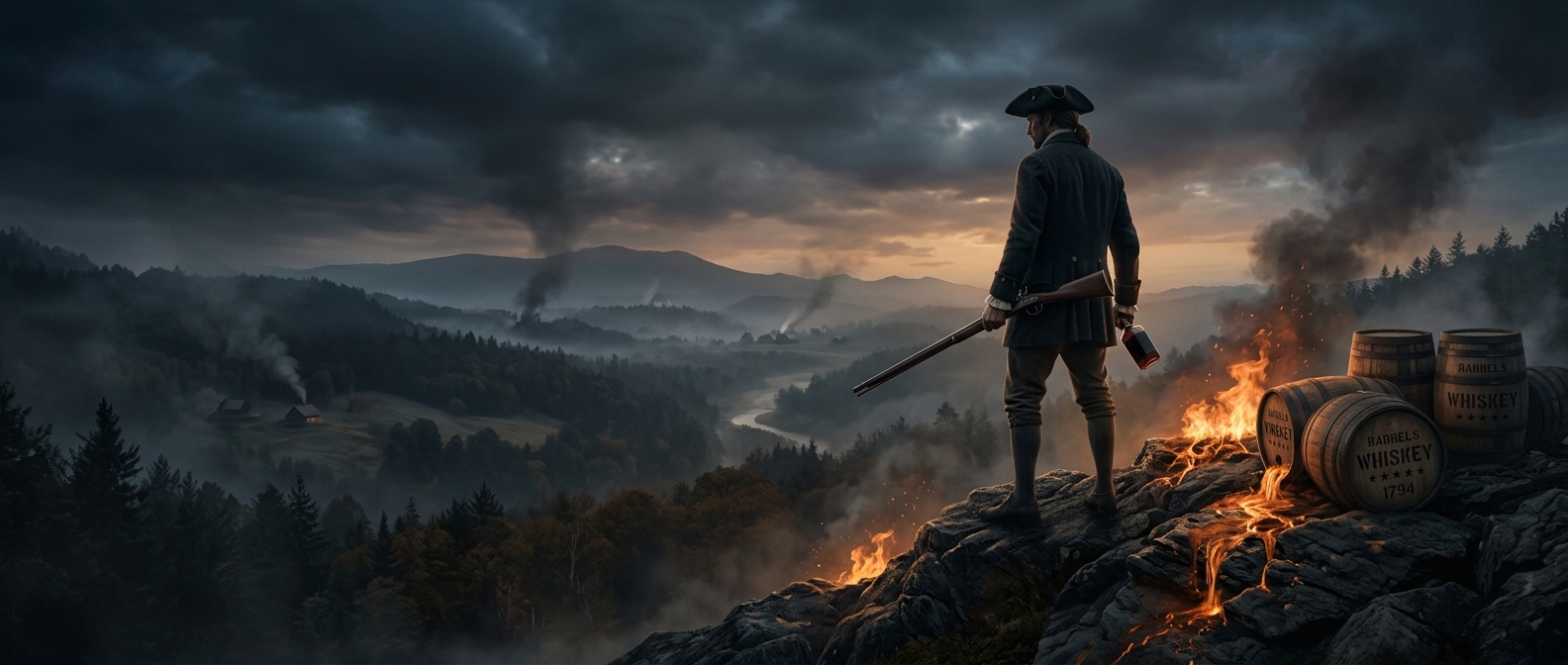
Why a Tax on Whiskey Hit Frontier Farmers Hard
In the early United States, western farmers faced a costly problem: grain was bulky, perishable, and difficult to haul over rough roads to distant markets. Distilling it into whiskey made it easier to store and transport. In places where coins were scarce, whiskey could also be traded for goods or services. It was not just a drink; it was a practical way to turn a harvest into something farmers could carry, sell, or barter.
How the Federal Tax Changed the Deal
In 1791, the federal government imposed an excise tax—a tax on making or selling a particular product—on distilled spirits. That meant a farmer who turned grain into whiskey owed the government money for the whiskey produced. The tax was especially burdensome for small western distillers, who had less cash on hand and fewer convenient ways to reach tax officials or courts than producers near the eastern centers of government.
The disagreement was about more than the amount owed. Farmers saw the tax as a demand for cash from people whose local economy often worked through trade and barter. Resisting it could also seem like a defense of local control against a distant federal government. Officials, meanwhile, needed the new government to collect revenue and show that its laws applied beyond the established eastern states.
From Resistance to a Test of Federal Power
Protests and intimidation escalated into open resistance in western Pennsylvania in 1794. President George Washington called up roughly 13,000 militia members to enforce the law. The show of force helped end the rebellion without a major battle, demonstrating that the federal government could mobilize citizens to carry out its laws.
Washington later operated a distillery at Mount Vernon, but it was built in 1797, after the rebellion. The striking irony is real, but it does not mean his distillery was operating when he sent the militia: the confrontation was about whether the young government could collect a tax at all.