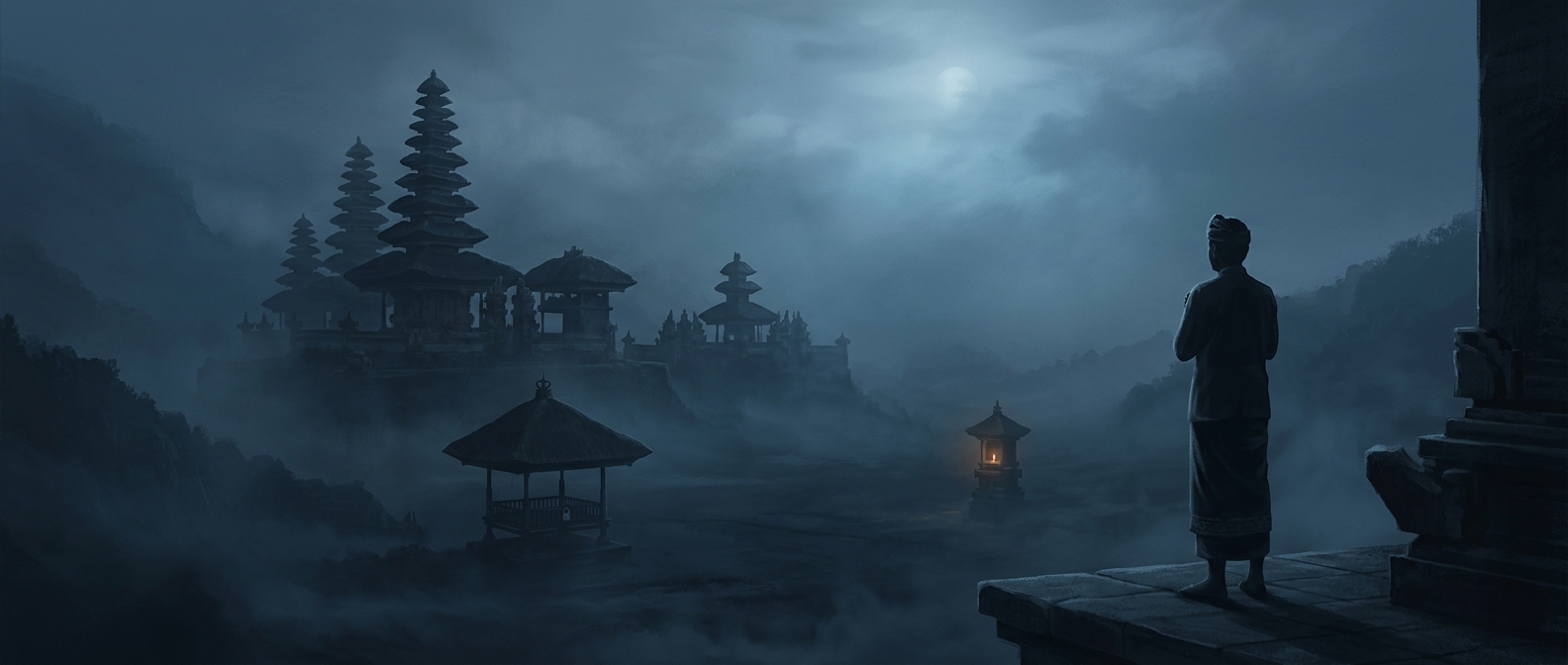
A New Year Marked by Stillness
Nyepi is not simply a day when Bali closes down. For Balinese Hindus, it begins the Saka calendar year with a deliberate pause for reflection and renewal. Rather than welcoming the year with public celebration, the island observes a day of restraint: people stay home, keep activity low, and turn their attention inward.
The quiet is part of a larger sequence. In the days before Nyepi, communities hold ceremonies and processions, including the lively Ogoh-ogoh parades, in which large effigies are carried through the streets. The contrast is intentional: noise and movement give way to stillness when the new year begins.
How the Island Makes Silence Possible
Nyepi is organized through Bali’s local communities, not only through individual choice. Traditional village institutions coordinate observance, while pecalang—customary community security officers—help uphold it. Their presence makes the rules visible in public space, while households take responsibility for keeping daily life quiet at home.
The shutdown also depends on broad cooperation. Businesses and public services suspend ordinary activity, and the airport’s closure means flights do not simply pass over or bring visitors into the island during the observance. For travelers, that requires planning around a day when normal movement is not available; for residents, it creates a rare shared interval with little traffic or public noise.
Quiet as a Collective Practice
The point is not just to produce an unusual spectacle for visitors. Nyepi gives people a common boundary around the day: the whole island participates in making less sound, using less light, and doing less. Its stillness is something people create together, through custom, community coordination, and personal restraint.
That is why the silence can feel so striking: it is not an empty island, but a populated one choosing, for a day, not to move as usual.