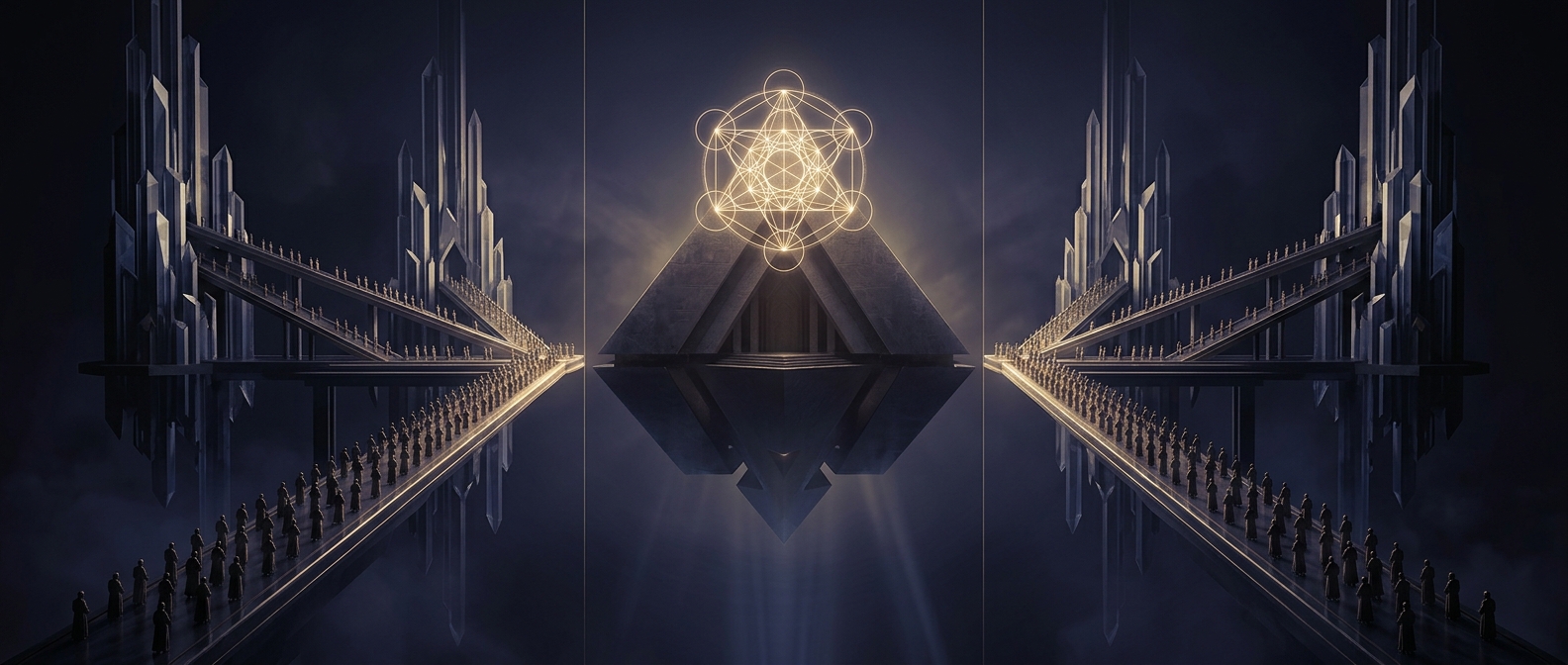
Why Simple Shapes Carry Sacred Meaning
Sacred geometry is not one universal doctrine. It is a family of spiritual and artistic traditions that treat geometric forms as more than decoration: a shape can serve as a symbol, a focus for meditation, or a model for how order is organized. The claim that triangles “rule reality” is best understood in that symbolic sense, not as a scientific law.
A triangle is compelling partly because a few lines create a stable, recognizable structure. In different systems, it may suggest a three-part relationship—such as beginning, middle, and end—or represent a particular spiritual principle. Its meaning depends on the tradition and context; the shape does not carry one fixed message everywhere.
From Pattern to Worldview
Hexagons and other repeated forms can likewise suggest balance, connection, or orderly growth. When practitioners notice similar patterns in art, architecture, ritual diagrams, or the natural world, they may read those resemblances as signs of a deeper unity. The geometry becomes a way to contemplate that belief: a simple shape offers something concrete to look at while considering an abstract idea.
That is why sacred geometry can feel both visual and philosophical. It turns an expansive claim about the universe into a form a person can draw, arrange, or study. The shape’s power lies in the meaning people use it to hold—not in proof that the cosmos is literally governed by triangles.