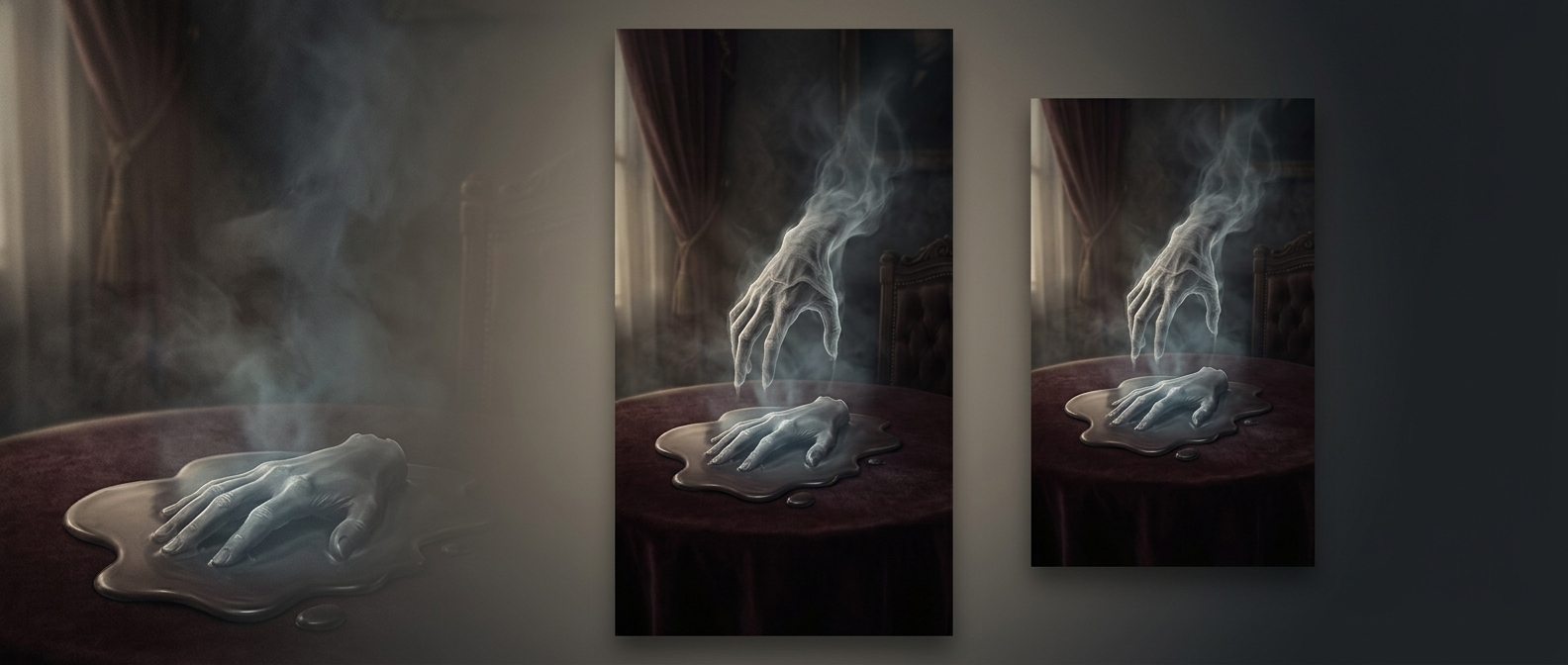
Why a Wax Handprint Looked Like Evidence
In séances, a delicate wax shell shaped like a hand could be presented as a physical trace of a spirit’s appearance. Its appeal was immediate: unlike a spoken message, a shell could be passed around and inspected. The more lifelike and complete the fingers seemed, the harder it was to explain how the object had been made without an actual hand inside it.
The puzzle was one of fit. A thin shell can copy the ridges and contours of a hand, but a rigid shell shaped around curled or spread fingers may form narrow sections that catch when the hand is pulled out. If the wax cracked during removal, the resulting object would no longer look like an intact impression. That difficulty helped give the shells their reputation as “perfect” molds.
The Mold Was Also the Challenge
The shell’s shape did not, by itself, settle how it had been produced. A hand-shaped object could be made by forming wax around a hand, but an intact result required some way to release it without tearing the fragile fingers. The wrist opening, the position of the fingers, and how rigid the wax had become all mattered. These practical details turned the object into a kind of test: could an ordinary hand be withdrawn while leaving the shell whole?
Skeptics argued that it could not, treating an undamaged mold as evidence that no living hand had been inside it. Believers could read the same difficulty in the opposite way—as support for a spirit manifestation. The controversy rested on a simple, tangible question: how could a hand-shaped shell preserve every finger and still come away intact? That is why the wax itself, rather than the séance story alone, became the center of the dispute.