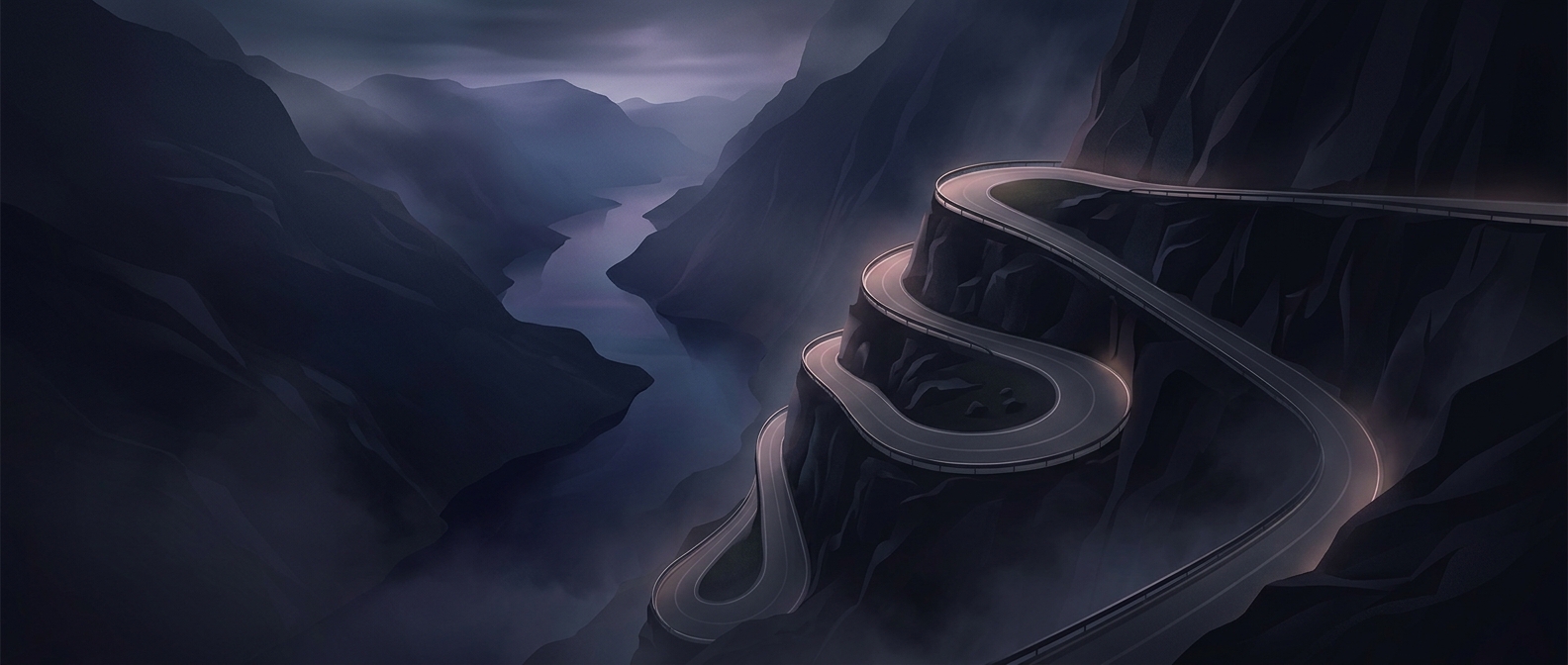
A steep climb made into a winding road
A 20% gradient means the road rises about 20 meters for every 100 meters traveled horizontally. A straight route up such a slope would be brutally steep, so the builders folded the climb back and forth across the mountainside. Each hairpin turn lets the road gain height over a longer path rather than charging directly uphill.
The result is a compact sequence: 13 sharp reversals packed into 1.5 kilometers. The turns are not decoration; they are the mechanism that makes the ascent possible on the available terrain. They also require travelers to slow down and negotiate the climb one bend at a time.
A route cut into the mountain
Building the road by hand in the 1840s meant shaping a passage directly into steep ground, instead of relying on modern earth-moving machinery. The alignment had to work with the mountain: carve a ledge, cross the slope, then turn back to continue upward. That winding geometry made access possible where a direct road would have demanded a far steeper line.
The destination mattered, too. The route connected travelers with a hotel and a waterfall, making the difficult approach part of reaching a place people wanted to visit. Its turns reveal the practical bargain behind the scenery: the road spends distance to make height gain manageable. Even today, the climb’s shape tells the story of how people engineered access through terrain that offered little room for a straight line.