How Santorini’s White Walls Became Standard
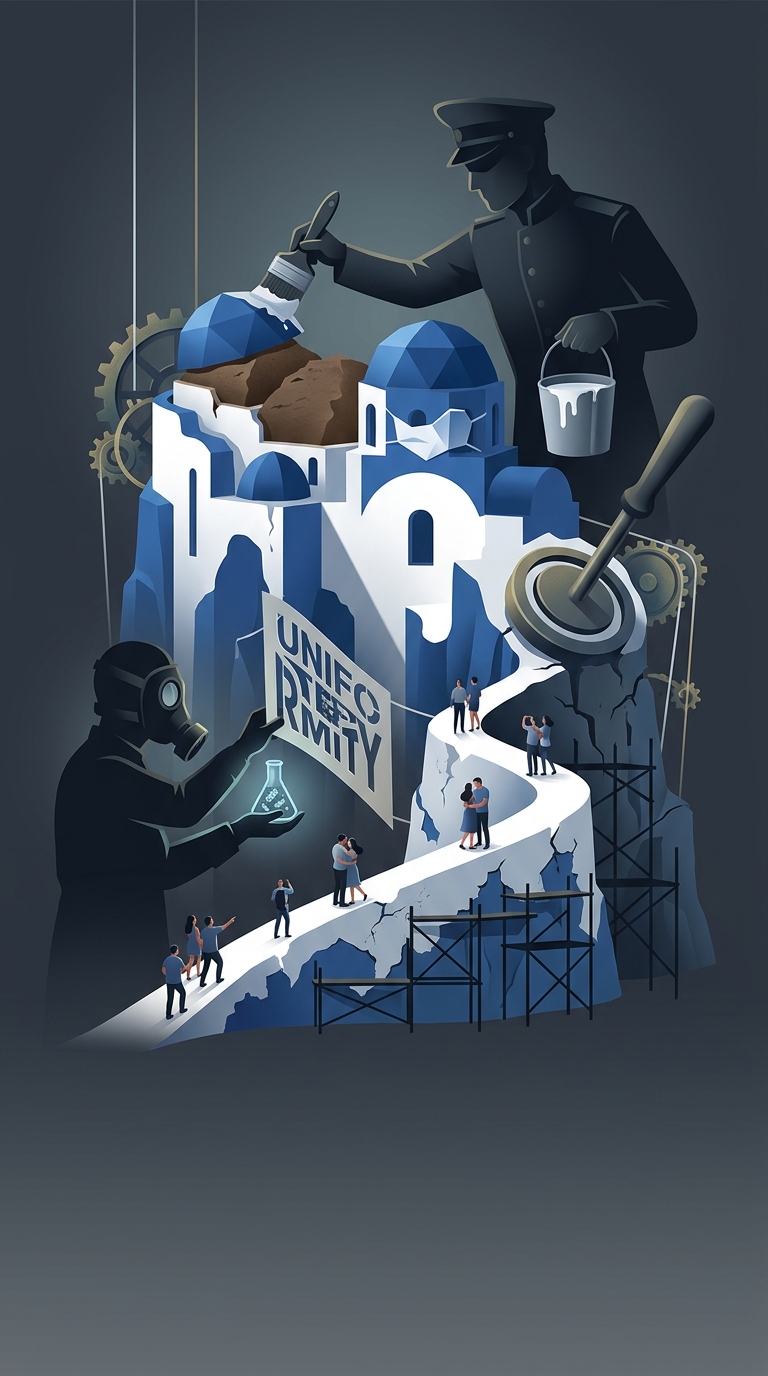
The island’s whitewashed look is often treated as an inheritance from antiquity, but its familiar uniformity is much more recent. Whitewash—a thin coating made from lime—was promoted during a cholera outbreak because lime could help disinfect surfaces. The practical public-health measure also made buildings look strikingly alike.
In the 1960s, Greece’s military dictatorship pushed that visual consistency further, enforcing whitewashing as a way to impose uniformity. The result was not a single architectural style invented at once: Santorini’s buildings had their own forms and histories, but a shared white surface made the island’s villages read as a coherent whole.
Why the Blue Domes Became the Image
The blue roofs and domes now associated with Santorini became prominent later as the island was marketed to visitors. Their color echoed the blue of the Greek flag, pairing a recognizable national symbol with the bright white buildings. That contrast photographs especially clearly, helping a collection of local structures become a compact image of “the Greek islands.”
So the postcard look carries several layers: limewash promoted for sanitation, political pressure that standardized appearances, and tourism imagery that made blue-and-white architecture instantly recognizable. What seems like an ancient, unchanging tradition is also the result of public policy and choices about what visitors would remember.