How a hazel fork became a “knower”
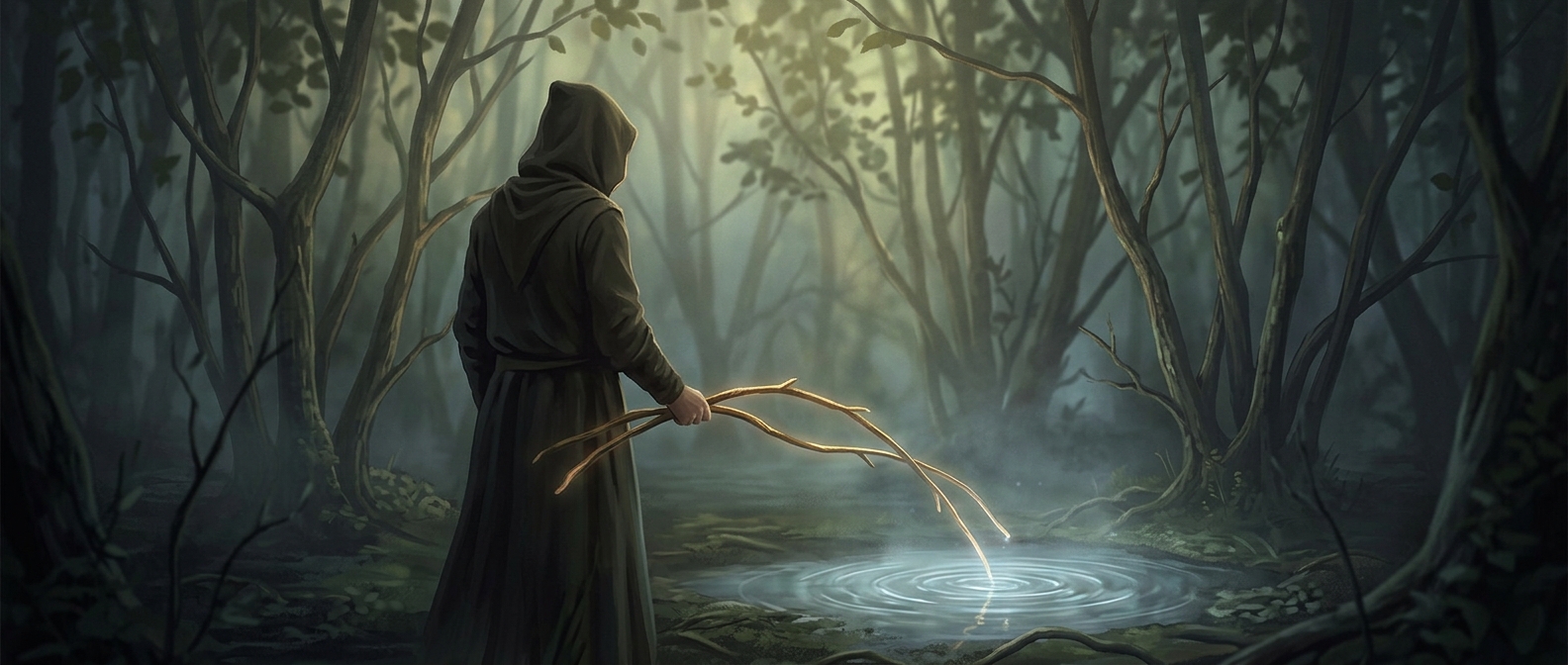
A forked hazel twig offered dowsers a tool that seemed to turn a hidden landscape into a physical signal. The dowser held one prong in each hand, with the fork pointing forward, and walked over ground where water was suspected. A dip or twist in the branch was taken as a sign of groundwater below.
Calling hazel “the knower” gives the branch a role beyond that of a handle: it becomes an apparent interpreter of what people cannot see. In a landscape where wells mattered, the hope of finding water without digging blindly made such a sign compelling.
What moved the branch?
A hazel fork is flexible, and a person gripping it can make it bend with very small hand movements. Those movements may happen without conscious intent—a phenomenon called the ideomotor effect, in which expectation produces subtle muscle action. The dowser may sincerely feel that the twig responds on its own.
That does not mean every successful well was imaginary. Groundwater can be widespread or relatively shallow in some places, so a well may find water whether or not the rod identified its exact location. When the branch dipped and digging later reached water, the sequence could feel like confirmation; when it did not, the failure might be less memorable.
The hazel fork’s power, then, lay in joining a practical need to a vivid sign: a slight movement in the hands could seem to make the invisible underground legible.