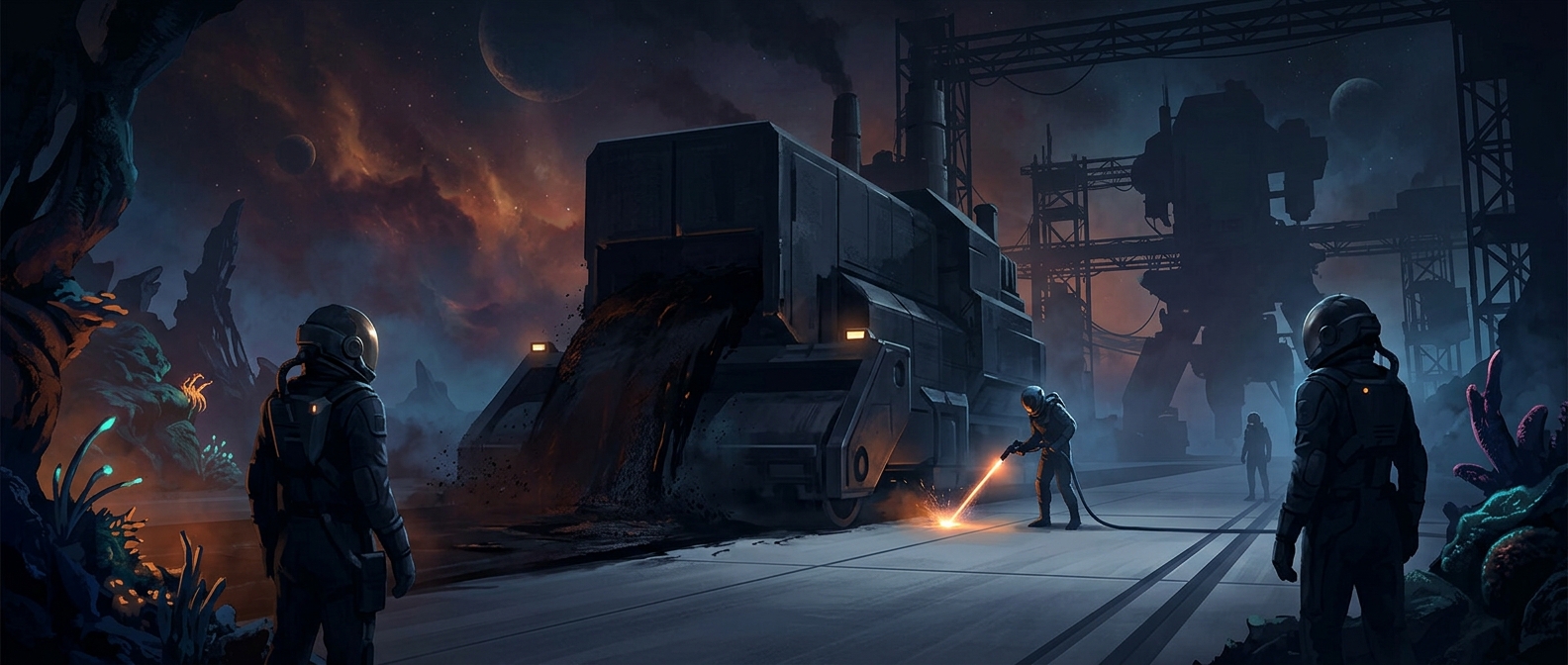
In Factorio, expansion has a physical footprint
The factory is not an abstract menu of upgrades: machines, belts, pipes, and power lines occupy the alien landscape. As production grows, the player lays down more infrastructure to move raw materials through a chain of machines and turn them into useful goods. Concrete is part of that build-out—and it also lets the engineer move faster across paved ground.
Plastic shows how one product can pull the whole operation outward. Making it requires chemical processing, which in turn depends on a steady supply of industrial inputs. To scale up, the player must connect extraction, refining, power, and manufacturing rather than simply click a button to increase output.
More production creates a new problem
That industrial chain has a cost in the game world: factories release pollution, which spreads beyond the machinery that produces it. Nearby native creatures respond to the contamination and may attack the source, turning a decision to expand into a defense problem as well as a supply problem.
The result is a deliberate tension. A larger factory can produce the materials needed for better defenses and still make the surrounding environment more hostile. The player’s concrete grid is therefore both a practical solution—easier movement and organized production—and a visible sign that the operation is taking over the planet. Every added line of production can increase output, but it also gives the factory more ground to protect.