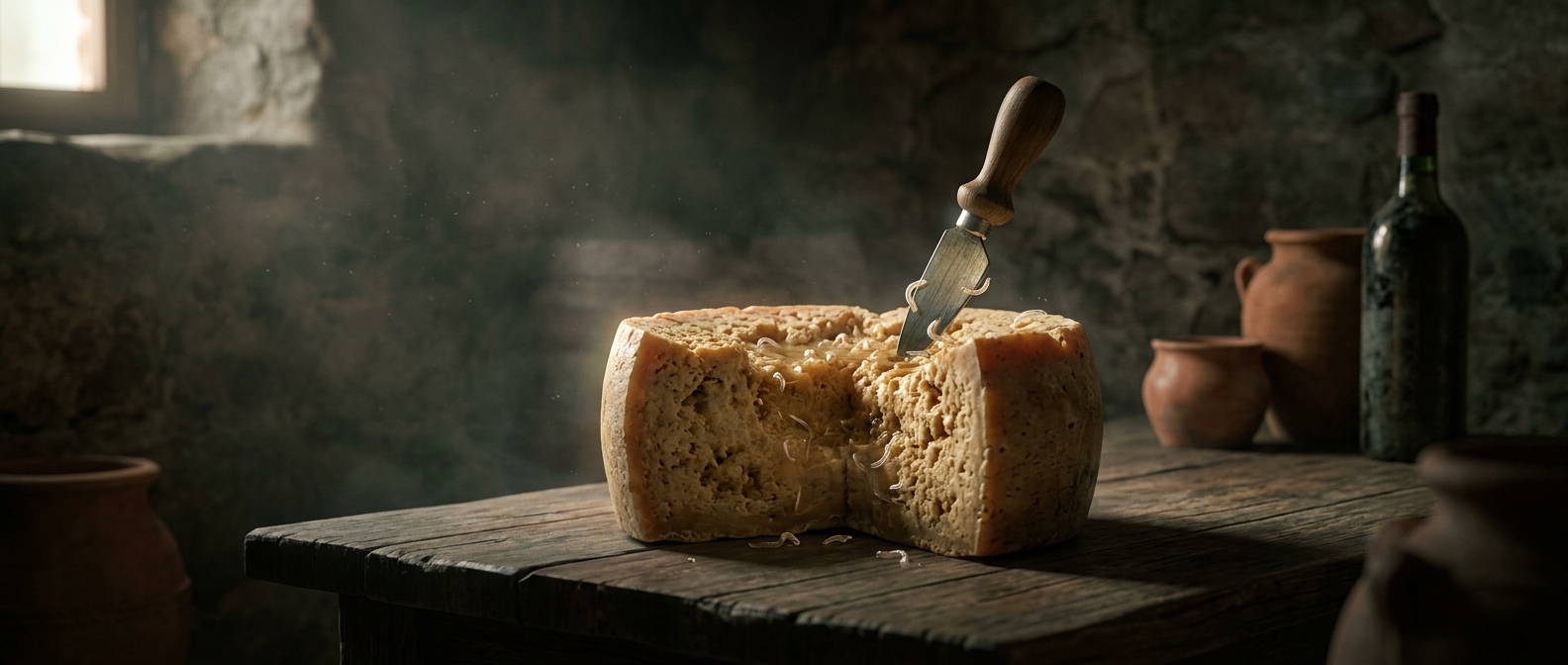
How Sardinia’s cheese becomes casu marzu
The transformation begins with a familiar base: sheep’s-milk cheese, often a pecorino-style wheel. During production, the rind is opened or removed in places and the cheese is left accessible to cheese flies. The flies lay eggs; once the larvae hatch, they feed inside the wheel.
Their digestive enzymes break down fats and proteins, changing the cheese from firm to exceptionally soft and creamy. This is not simply a matter of adding an unusual ingredient: the larvae actively alter the cheese’s texture and flavor as they feed. The name casu marzu is commonly translated as “rotten cheese.”
A living part of the food
That process makes casu marzu strikingly different from cheeses whose aging is controlled only by time, temperature, and selected microbes. Here, the larvae are part of the product while it is being made—and, in traditional servings, may still be alive when the cheese reaches the table. Their movement is one reason diners sometimes cover their eyes, as the caption notes.
The result is associated with Sardinia’s rural food traditions, where making use of local milk and allowing cheese to develop in a distinctive way produced something with a strong identity. Its unusual method is also why the cheese is discussed as much for how it is made as for how it tastes. A wheel that might ordinarily be judged by firmness has, in this case, been transformed by the creatures living inside it.