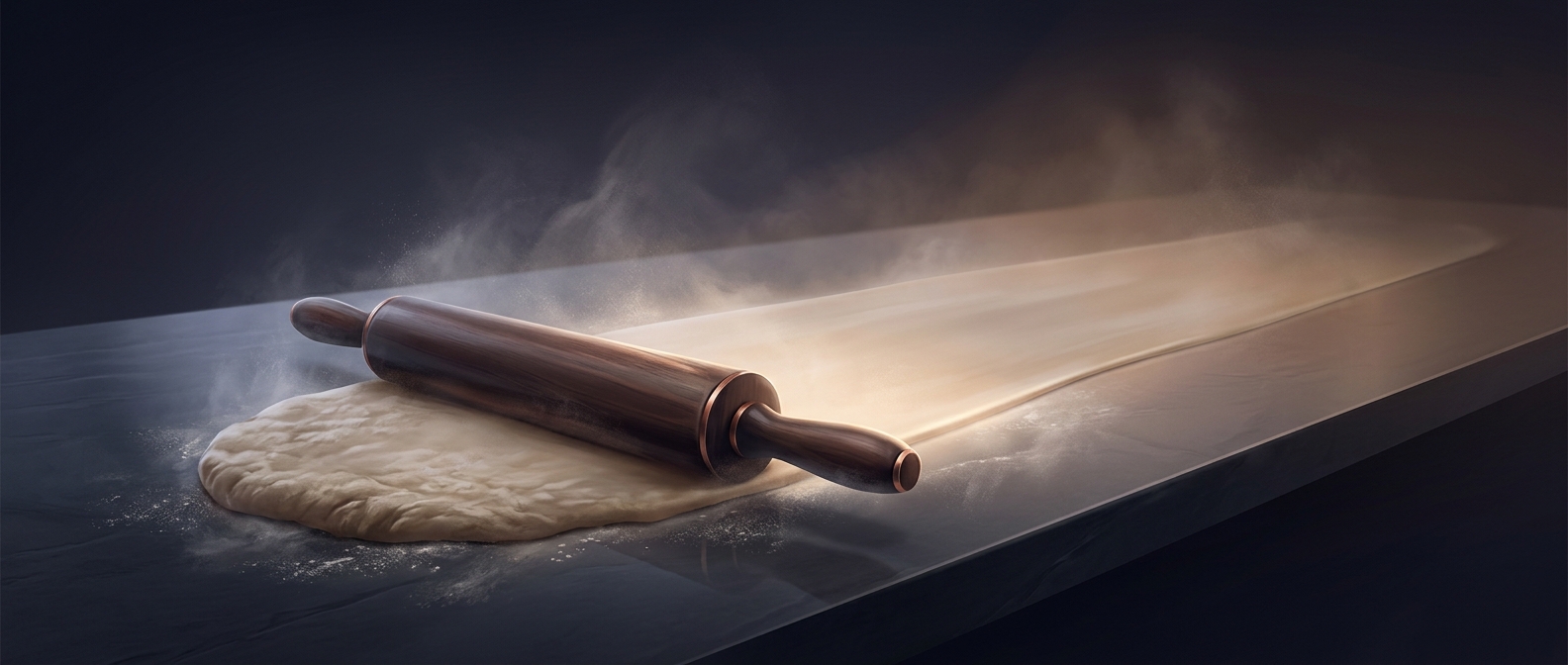
A roller moves pressure across the dough
A rolling pin works by turning a downward push into a moving band of pressure. As the cylinder travels over the dough, its weight and the baker’s hands compress one small area after another. The dough spreads outward because it cannot simply compress in place: its soft, elastic structure shifts sideways as it thins.
The pin’s rotation matters. Instead of dragging a broad, flat object across the dough, the baker lets a curved surface roll over it. That helps keep the sheet moving smoothly while repeated passes gradually bring thicker spots closer to the same height.
The sheet becomes easier to move
A uniformly thin piece is less likely to sag or tear in one heavy patch when it is lifted. Bakers can also wind the dough loosely around the pin, carry it over a pan, and unroll it into place. The tool therefore does more than shape the dough: it helps turn a floppy mass into a manageable sheet.
That is the useful part of the road-roller comparison. The pin does not transport dough by itself; it prepares the dough for transport by spreading it into a form that can be handled. A few smooth passes can make the difference between wrestling with a lump and laying pastry neatly into a pan.