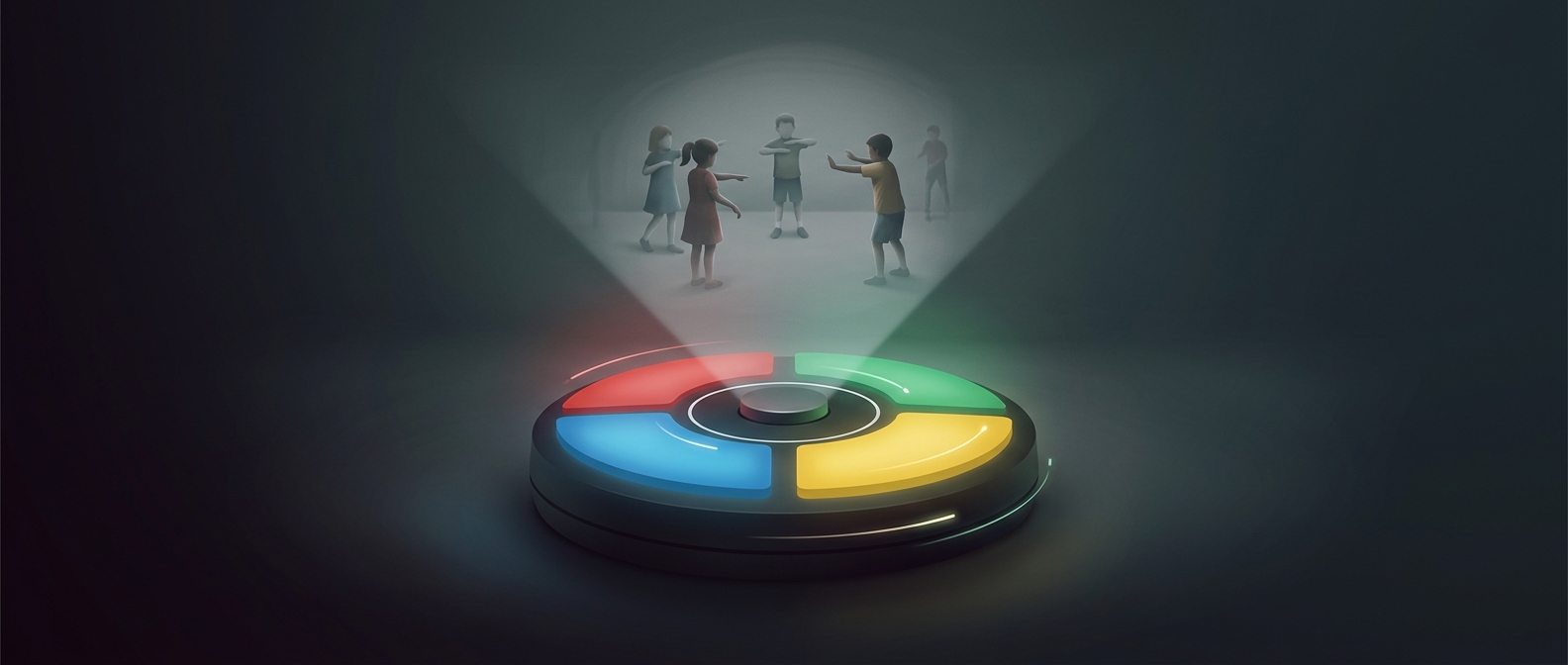
From Following Orders to Remembering a Pattern
The playground game Simon Says tests whether players can listen carefully and distinguish valid commands from tricks. The electronic game Simon keeps the call-and-response structure but changes the task: instead of deciding whether to obey, players must reproduce a sequence of colored lights and tones.
That shift turns a social game into a test of attention and short-term memory. Each new cue becomes part of a longer pattern, so players have to hold earlier steps in mind while watching and listening for the next one.
Why the Electronic Version Works
Simon makes its instructions unusually clear: a light flashes, a tone sounds, and the player presses the matching colored button. The same buttons serve as both the display and the controls, linking each cue directly to an action. A mistake is easy to recognize—the player’s response no longer matches the sequence.
The design preserves the playground game’s basic rhythm: one side presents a cue, and the other responds. But by making the sequence grow, it gives the simple exchange a built-in escalation. A child’s command game becomes a compact challenge of remembering what came before as well as reacting to what appears next.