One wheel has to do two jobs
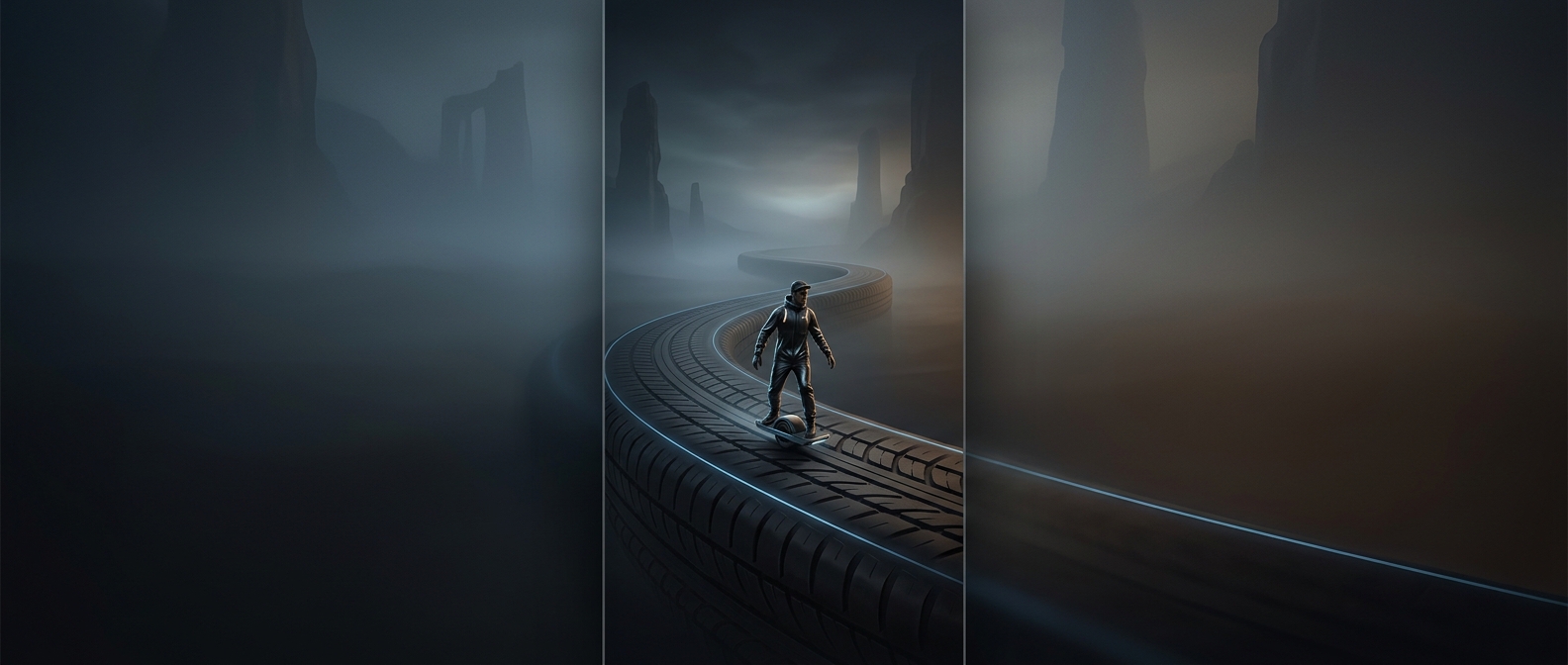
A Onewheel has no separate suspension fork or pair of wheels to spread out bumps. Its broad, air-filled tire is the board’s only contact with the ground, so the tire flexes when it rolls over small cracks and uneven pavement. That deformation cushions some of the impact before it reaches the rider.
Because the tire is also the vehicle’s sole support, its shape and pressure affect more than comfort. The tire must stay compliant enough to absorb roughness while remaining firm enough to carry the rider and respond predictably to steering and speed changes.
The board balances by moving the wheel
Inside the board, motion sensors track its angle and acceleration. When a rider shifts forward, the board interprets the change in pitch—the tilt toward the nose—as a request to move ahead. Its motor turns the wheel forward, bringing the platform back beneath the rider. Leaning back prompts the opposite response.
This is a continuous control loop, not a one-time adjustment: the sensors detect a change, the controller calculates a response, and the motor applies it. The rider supplies the balance and the intended direction; the electronics help keep the board from simply tipping over.
The tradeoff is concentrated at the tire
On a conventional board, several tires and a suspension system can share the work of crossing rough ground. On a Onewheel, the single tire must provide grip, absorb bumps, and transmit the motor’s force—all through one narrow contact patch. That makes the riding surface especially noticeable: a change in pavement is felt directly through the wheel that is also keeping the board upright.
The result is a design with fewer wheels and moving suspension parts, but a more demanding balance between tire cushioning and control. The tire is not just what the Onewheel rolls on; it is the link between the road, the motor, and the rider’s balance.