The edge is part of the book’s design
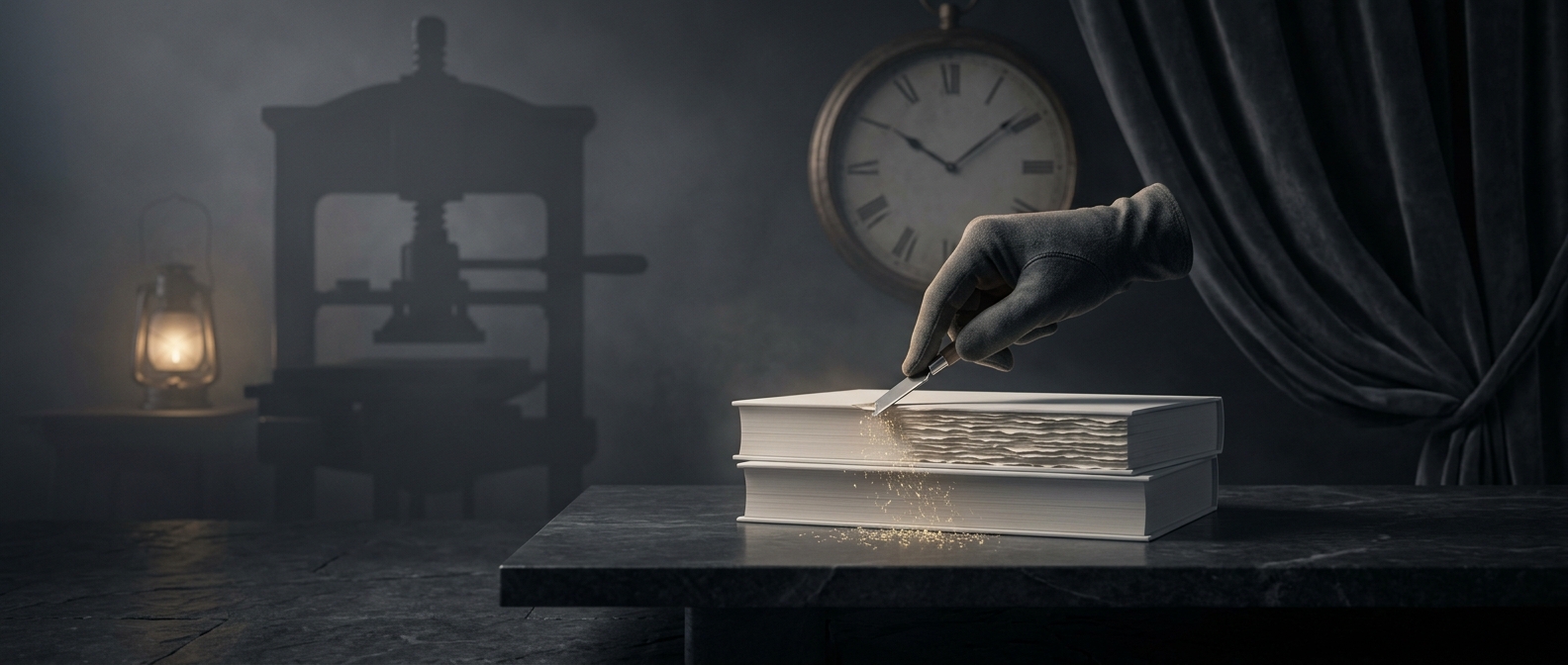
A book’s fore-edge is the side opposite its spine—the edge you see when the book is closed. Most modern books have this edge trimmed into a smooth, even plane. For a deliberately aged effect, a publisher can instead leave the sheets’ edges irregular or give them a rough, uneven cut. The pages then look less like a perfectly finished stack and more like paper that has softened and shifted with age.
The look draws on older bookmaking, when paper sheets were often folded and gathered into sections before binding. Their exposed edges could remain uneven rather than being trimmed flush. Some pages in such books might also need to be cut open by a reader. Today, an irregular edge can evoke that hand-finished quality without the book actually having spent decades on a shelf.
Texture comes with a tradeoff
A smooth fore-edge gives each page a clear, consistent boundary, so a thumb can catch and separate sheets easily. Uneven edges create more friction and make the stack less uniform. Pages may cling together or resist a quick flip, especially when the edges are especially rough or the book is thick.
That tension is the point of the treatment: it changes how the book looks and feels, not just how it appears in a photograph. The same unevenness that suggests age can make the pages less convenient to handle. A reader turning a new book with rough edges is encountering a designed surface—one that trades some ease of use for the impression of a volume with a past.