A projectile with a signature silhouette
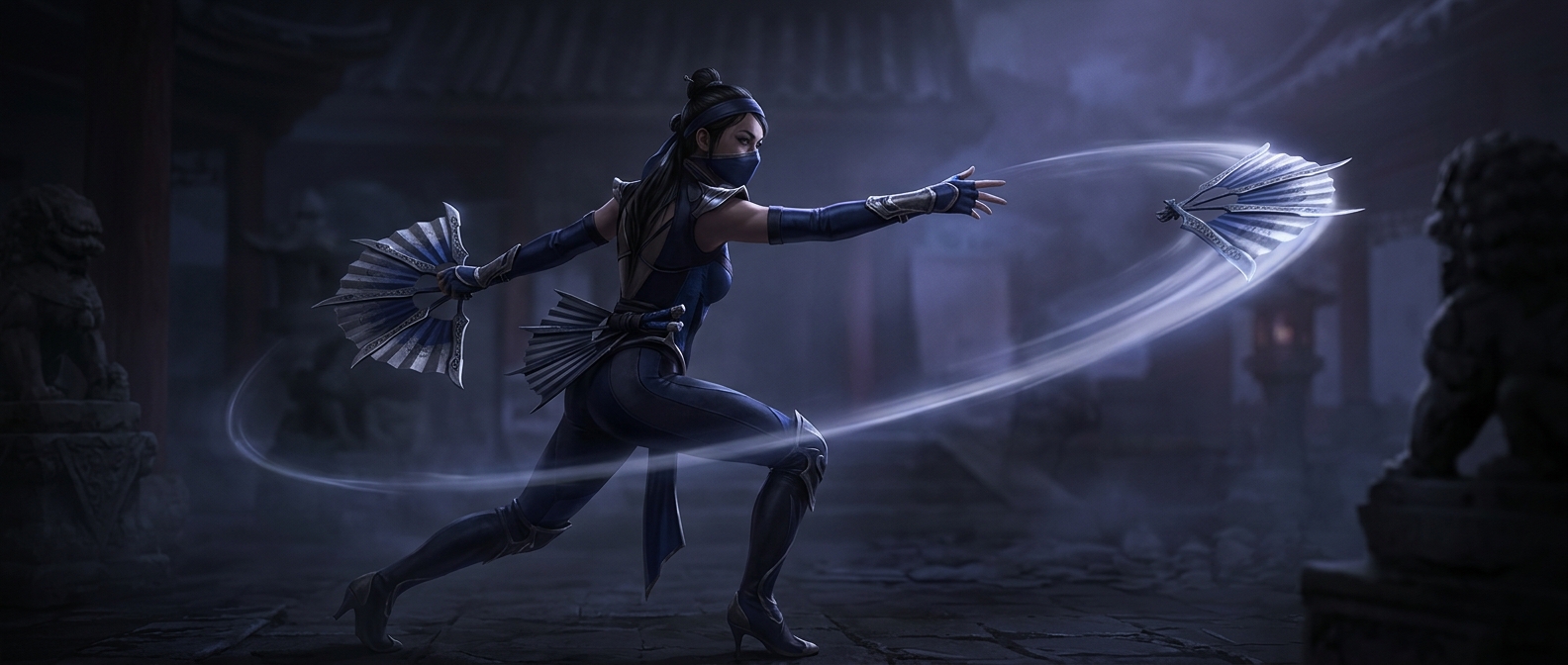
Kitana’s fans do more than give her a distinctive weapon. In a fighting game, an attack has to register quickly: players need to recognize what is coming, judge its reach, and decide how to respond. A broad fan spinning through the air has a different outline from the straight line of a sword swing, making her ranged attack visually legible amid fast movement.
The return arc adds a second beat to the move. The throw sends danger outward; the curve back toward Kitana makes the weapon’s path feel like one continuous action rather than a projectile that simply vanishes offscreen. It also preserves the image of her fighting with her own paired weapons instead of treating the throw as a disposable shot.
Style meets fighting-game function
The steel fans bridge two kinds of combat. Up close, they read as hand-held blades; at a distance, they let Kitana threaten an opponent without crossing the space between them. That gives the weapon a role in the visual language of a match: a fan attack signals that distance itself may not be safe.
The return is stylized rather than a lesson in real-world weapon physics. Its value is in the clear, memorable action it creates on screen. A thrown fan can leave Kitana’s hands, sweep across the arena, and still belong to her when the motion completes—turning a compact weapon into an unmistakable part of her fighting identity.