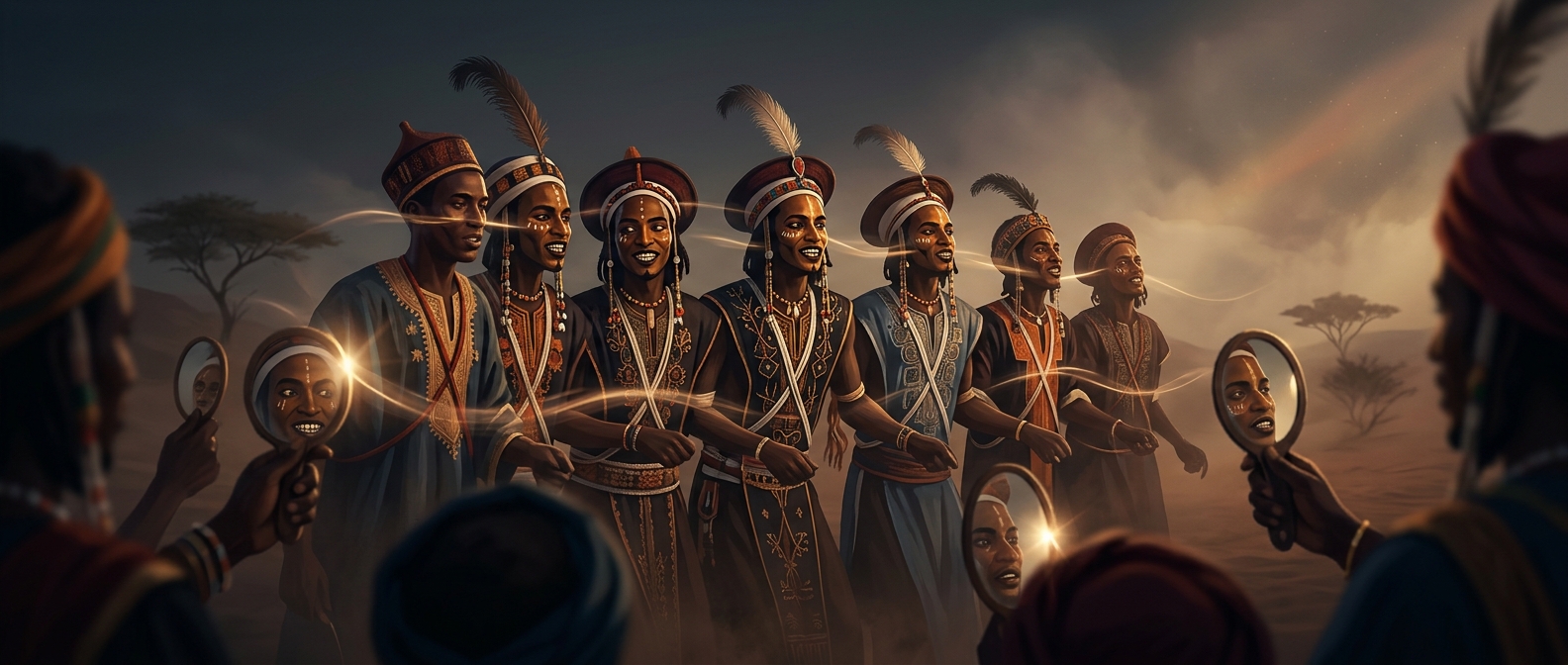
A courtship performance, not just a pageant
The Wodaabe are a traditionally nomadic, cattle-herding people of the Sahel, the broad dry region south of the Sahara. At gatherings associated with the Gerewol, men perform in elaborate dress and makeup while women watch. The dancing and facial expressions are not random spectacle: they make a man’s appearance and stamina visible to potential partners.
In the Yaake dance, men stand in a line and repeat rhythmic movements, widening their eyes and showing their teeth. These gestures draw attention to features valued in Wodaabe ideas of male beauty, including bright eyes and teeth. Carefully applied makeup heightens the contrast, so expressions can be read even in a large group.
What the judging means
Women’s role is more than scoring a show for entertainment. Their attention and choices give the performance its courtship stakes: men present themselves, and women can indicate interest. That reverses a familiar pageant script in which men do the choosing, though the event should not be treated as a single, uniform system followed identically by every Wodaabe community.
The gathering also brings people together across a pastoral landscape where families may otherwise be spread out. Dance, dress, and courtship happen in public, among relatives and peers—not in a sealed-off contest. The striking eye-rolling and tooth-baring are therefore both theatrical and practical: they turn beauty into something a crowd can see, compare, and respond to.