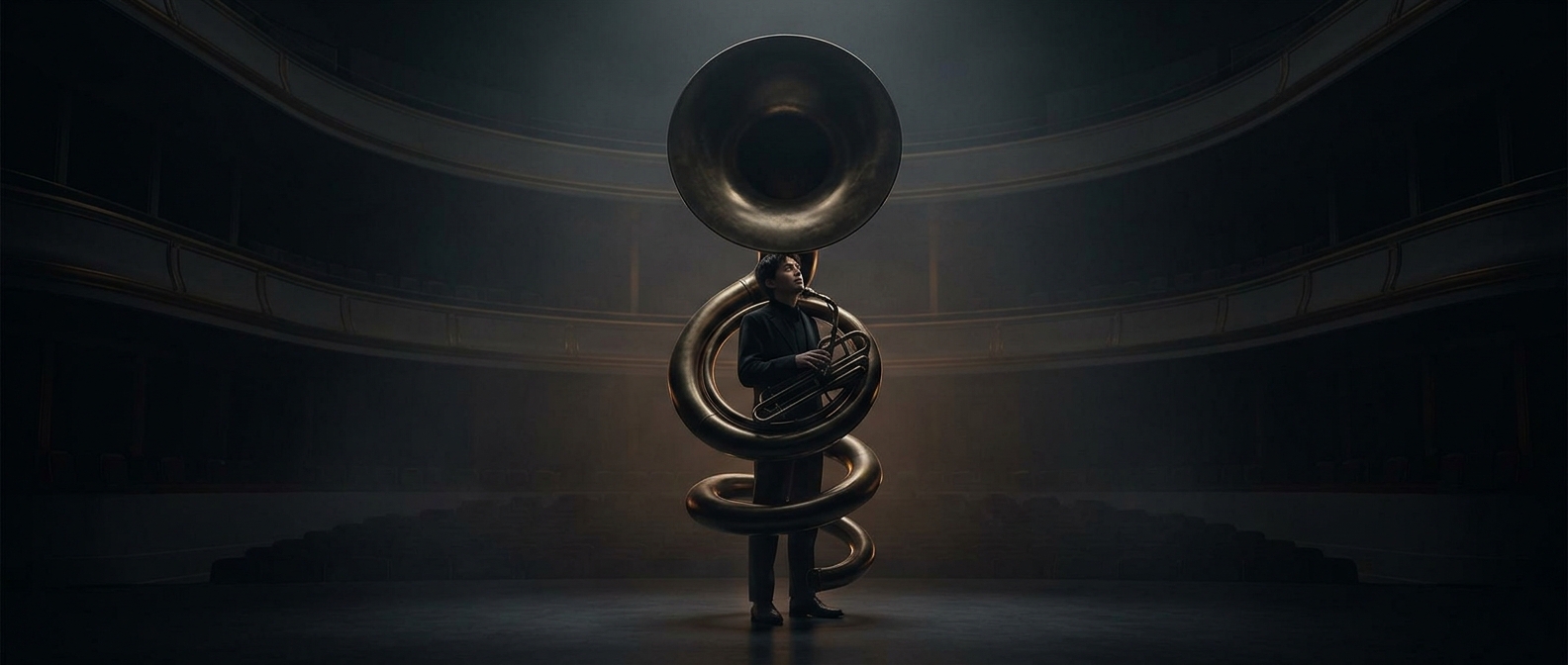
Why the sousaphone wraps around its player
A sousaphone is a large brass instrument built for a job a concert-hall tuba rarely has to do: move with a marching performer. Its long tube bends into a broad loop that sits around the player’s body, with the bell rising above the shoulder and facing forward. The performer can walk while keeping the instrument supported and the mouthpiece in playing position.
That shape is not just a way to make a huge instrument wearable. A conventional tuba’s bell points upward, which works well when the player is seated among an orchestra. For a marching band, a forward-facing bell sends the sound toward the audience in front of the player. The wide coil also brings the instrument’s weight close to the body rather than leaving a long, unwieldy tube sticking out to one side.
A tuba that can move with the band
The sousaphone makes its low notes the same basic way other brass instruments do: the player buzzes their lips into a mouthpiece, setting the air inside the tubing vibrating. Valves redirect the air through different lengths of tube, changing the pitch. The instrument’s large, coiled body provides the long air path needed for its deep register; its shape changes how it is carried and where the bell points, not the basic sound-making principle.
The result is a recognizable compromise: a tuba large enough to anchor a band’s low end, arranged so a performer can carry it through a formation. Its bell can loom over the player’s head, but the loop around the torso is what turns that bulk into a marching instrument.