Buoyancy turns a bicycle into a small boat
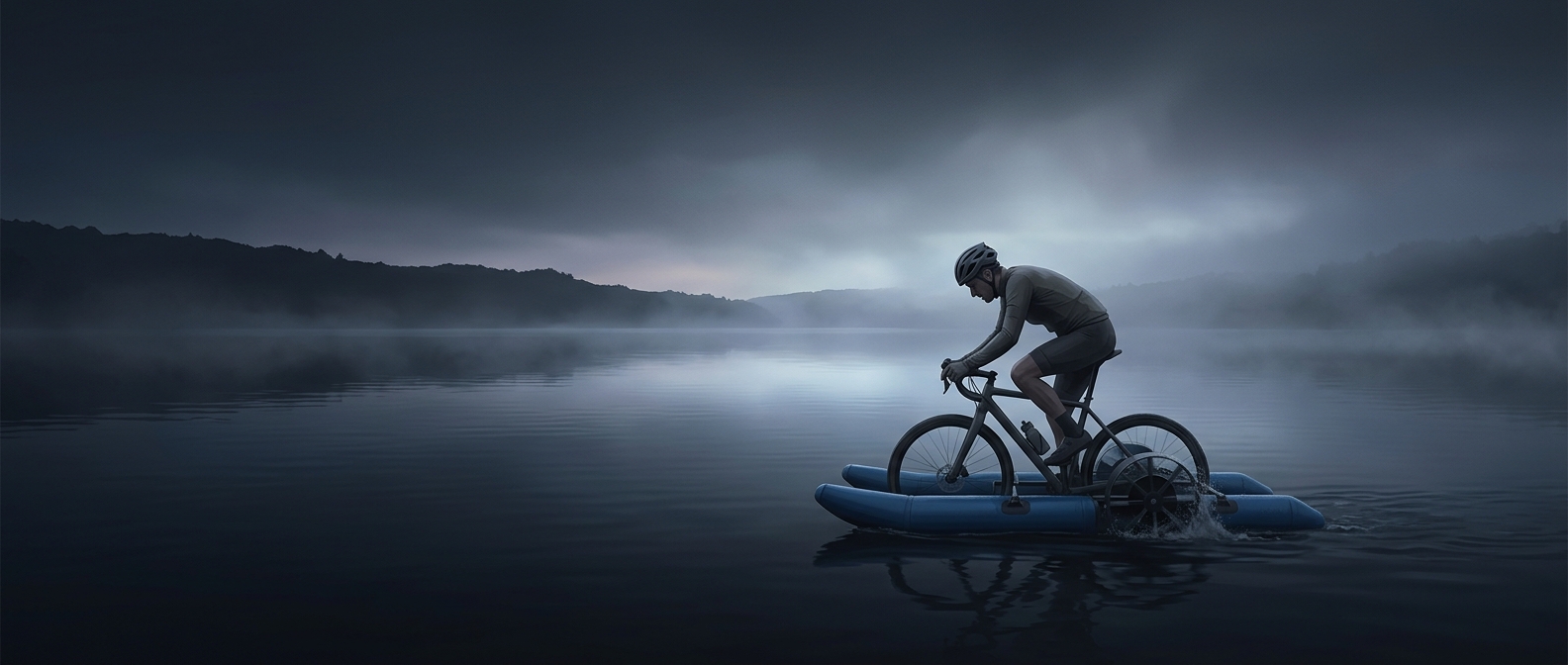
A bicycle cannot float on its own, so an amphibious design adds hollow floats—often called pontoons—alongside the frame. Each float displaces water as it settles into it; the upward force from that displaced water supports the bicycle and rider. The floats must provide enough buoyancy not just to keep the craft afloat, but to leave some reserve for movement, uneven loading, and small waves.
Their spacing matters as much as their volume. Set wide apart, the pontoons resist tipping from side to side, much like the outriggers on a canoe. That makes the craft steadier, but also bulkier and harder to maneuver than an ordinary bicycle. The rider usually sits between the floats, where the combined platform can support the weight without relying on the narrow bicycle tires for balance.
Pedaling needs a second drive system
On land, the chain turns the rear wheel; underwater, a wheel mostly churns water rather than pushing the craft efficiently forward. Floating bicycles therefore route pedal power to a propeller or paddle. A propeller pushes water backward to move the bike forward, while a paddle-style mechanism presses against the water in repeated strokes. Designs differ, but both convert leg power into thrust instead of road traction.
Steering is another adaptation. The front wheel may still help guide the craft, or a separate rudder may turn it through the water. Either way, water resists turning more than air does, so the craft responds less like a nimble bicycle and more like a small, slow boat. The pontoons solve the hardest problem—staying upright—but the added width and drag are the price of taking a pedal-powered ride beyond the shoreline.