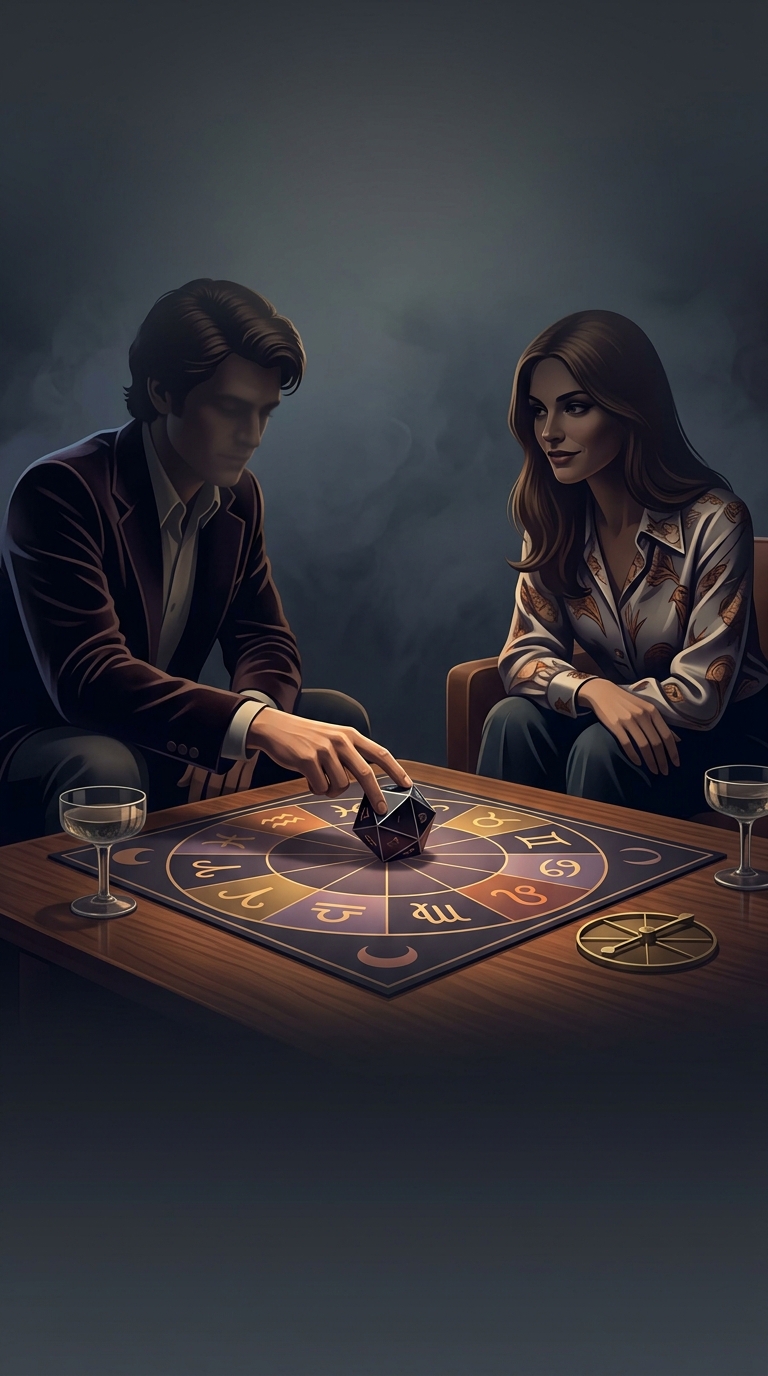
Turning star charts into a party game
Astrological compatibility can feel abstract: a chart is a collection of symbols, while attraction is personal and difficult to discuss in a room full of people. A game gave that subject a simple social structure. Players could use basic chart mechanics to sort people into apparent matches, turning private interest into something that could be raised as part of a shared activity.
The important move was simplification. Instead of asking guests to interpret a full chart, the game made astrology usable at the table: a roll or other game action produced a prompt or result, and the chart supplied a ready-made language for talking about compatibility. The result was not a serious assessment of a relationship so much as a playful framework for discussing one.
A playful excuse to cross a social line
At an adult dinner party, that framework could do more than entertain. Flirting with another guest’s spouse was socially charged; presenting interest as a game’s suggestion made it easier to broach without having to state it outright. Astrology supplied the rationale, and the game supplied the occasion. A player could treat a compatibility result as a joke, test how others reacted, or use it to open a conversation.
That double purpose helps explain the appeal of such games: they made flirtation both explicit enough to discuss and indirect enough to deny. The dice did not decide who was compatible. They gave the party a shared script for talking—and flirting—about the possibility.