Why a Horse’s Hair Becomes an Offering
In Mongolian pastoral life, horses are more than transport: they are companions, working animals, and a visible part of the bond between people and the landscape they depend on. Against that background, burning a few hairs can turn an ordinary piece of an animal into a ritual offering. The hair stands for the horse without requiring the animal itself to be given up.
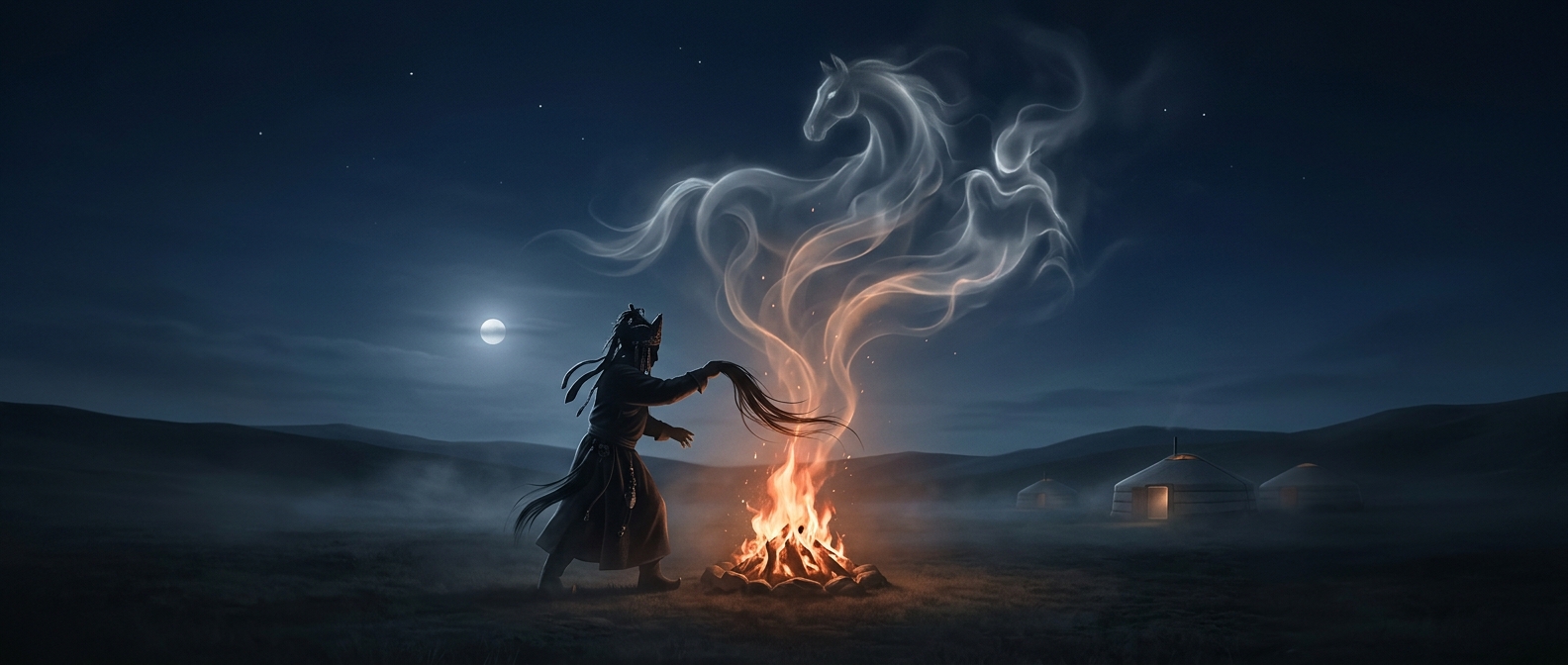
The ceremony’s logic is one of mediation. Believers understand the horse’s spirit as able to carry a human appeal beyond the immediate world. As the hair burns, its smoke gives that appeal a path upward and outward; protective spirits may then answer by keeping misfortune or harmful wandering forces at bay. Smoke matters here not as a chemical agent, but as a visible sign that something is being sent.
A Request Made Visible
The act joins material and spiritual worlds in a compact sequence: a person gives an offering, the offering becomes smoke, and the smoke conveys a plea. The hair’s connection to a living horse gives the gesture its meaning; the rising smoke makes the hoped-for passage easy to picture.
Such practices can vary among families and communities, so the ceremony should not be taken as a single rule followed by every Mongolian believer. Its striking detail is the scale of the offering: a small trace of a trusted animal becomes a messenger in a request for protection.