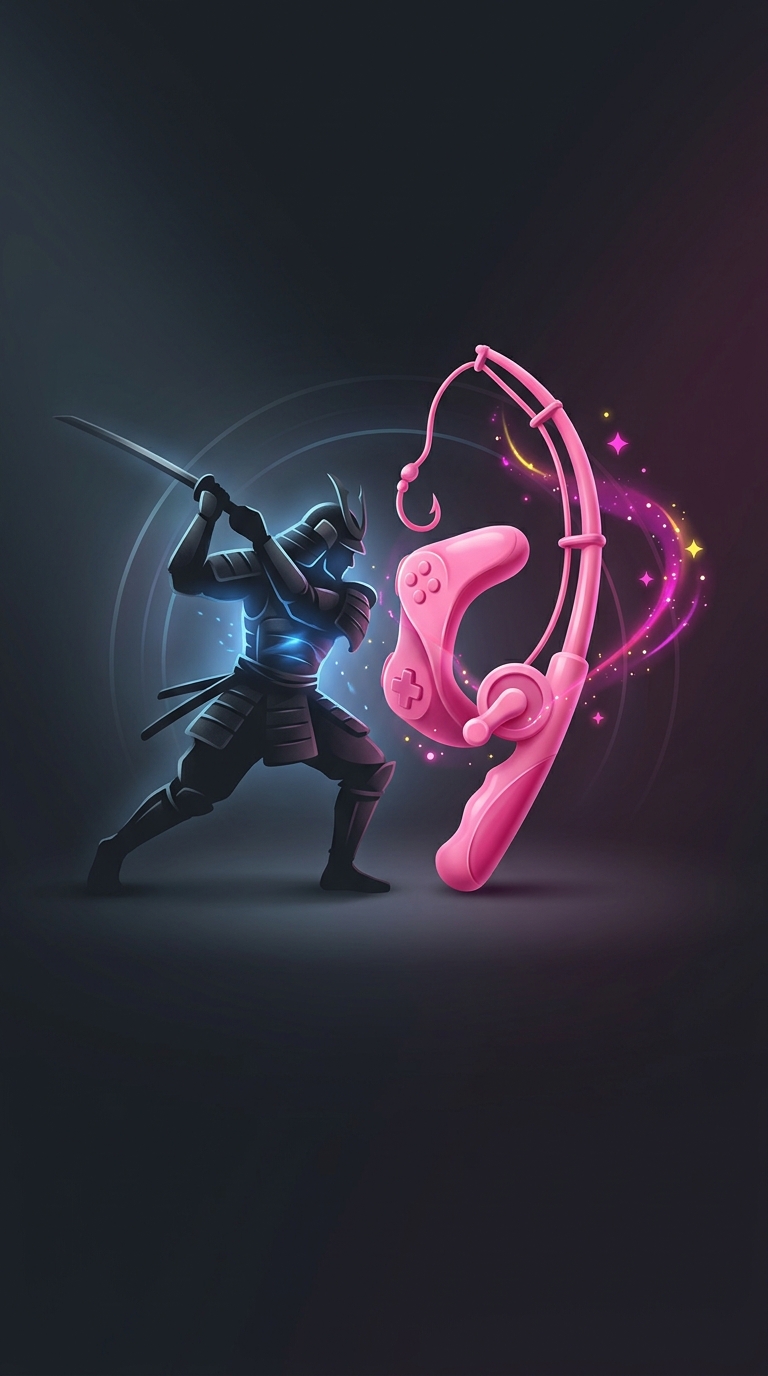
When a Fishing Cast Became a Fighting-Game Move
The Dreamcast fishing rod was designed to make casting part of play: instead of moving only a conventional thumbstick, a player could handle a rod-shaped controller and make fishing-style motions. But the console still received ordinary controller inputs. To another game, those signals were simply directions or button presses—not instructions that had to mean “cast.”
That made the accessory usable in Soulcalibur, a fighting game whose attacks are triggered by controller inputs. When the rod’s movement registered as an input the game could use, swinging it could set off an attack. The game was not simulating a sword or interpreting a fishing motion; it was responding to the control signal that motion produced.
The Unexpected Advantage of a Shared Controller Language
A purpose-built controller can feel very different in a player’s hands while still communicating through familiar inputs. That compatibility is what made the crossover possible: the fishing rod changed how a person moved, but Soulcalibur could still treat the resulting signal as a command.
The result was less a hidden feature than an unlikely meeting of design and hardware. A living-room fishing accessory could become a way to fight without swapping controllers—turning a tool made for casting into an improvised weapon in a game that had never been built around fishing.