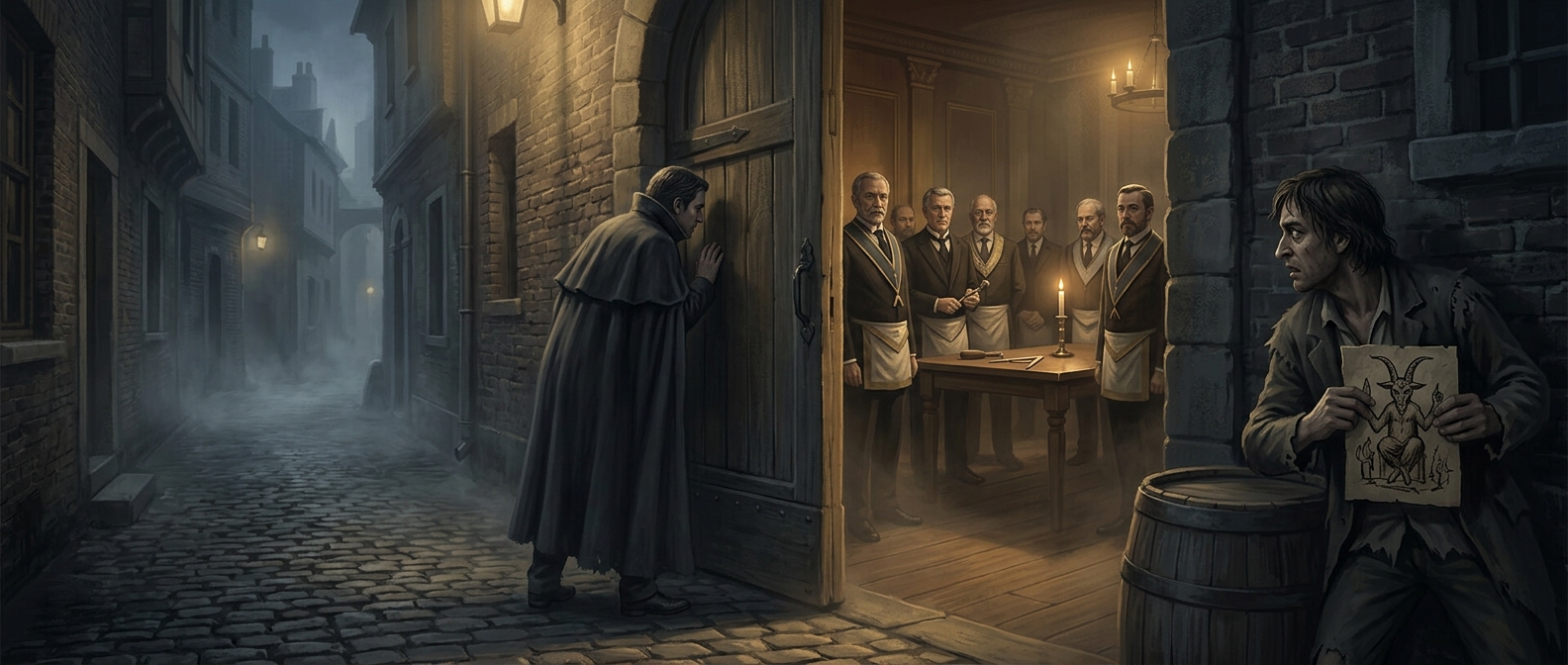
A secret club built around Enlightenment ideas
The Bavarian Illuminati began in 1776, when Adam Weishaupt, a professor at the University of Ingolstadt, organized a society for men who wanted public life guided more by reason than by religious authority. Its members favored education and reform, and the group’s outlook challenged the influence of the Catholic Church in a state where church and government were closely connected.
That did not make the Illuminati a mass movement for modern democracy. It was a small, selective association of educated men, organized in ranks and using aliases. Secrecy helped members communicate and build influence, but it also made the group harder for authorities to monitor—and easier for outsiders to imagine as more powerful than it was.
Why Bavaria moved against it
The society operated under a monarchy, not in a political system where it could openly campaign for a new relationship between church and state. Bavarian authorities prohibited secret societies in the mid-1780s, and the Illuminati was suppressed. The ban ended its organized activity in Bavaria, but official action also gave the group a lasting aura of danger: a society that had to hide could be portrayed as plotting against the government.
How a small society became a vast conspiracy
After its suppression, published accounts and political polemics recast the Illuminati as a hidden force behind major events, including the French Revolution. Those claims vastly enlarged the group’s apparent reach. The basic ingredients were already compelling: secret membership, political reform, religious tension and a government ban. Later conspiracy theories turned those ingredients into a story of an all-powerful organization.
The historical group was a limited Enlightenment-era society, not evidence of a secret hand controlling world events. Its afterlife shows how secrecy can magnify a political organization’s reputation long after the organization itself has disappeared.