Why Pop-Up Pages Resist Full Automation
A pop-up book is a paper machine concealed inside a page. When a reader opens it, folded panels pull on tabs, hinges, and supports, turning a flat sheet into a standing shape. For the effect to work, those parts must meet at precise angles: a small misalignment can leave a figure tilted, prevent it from rising, or make the page hard to close.
The Assembly Is Part of the Design
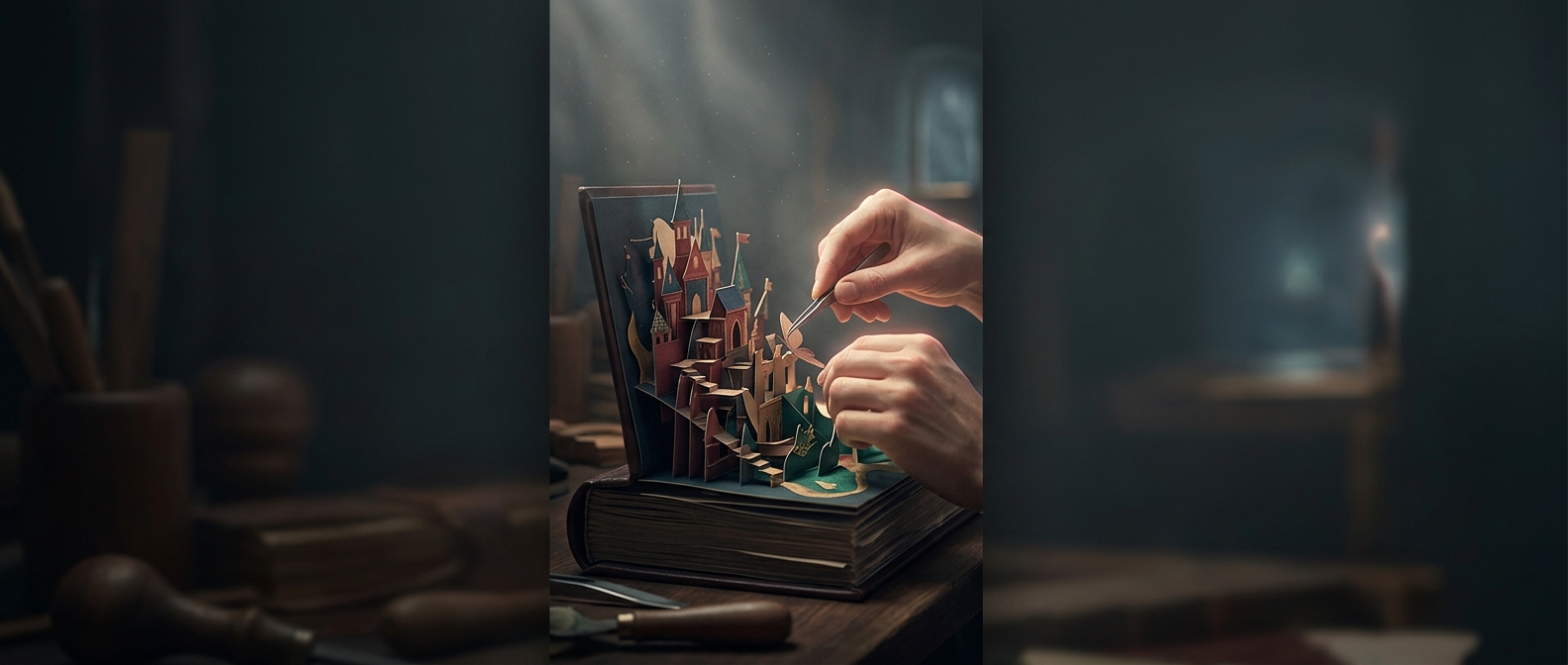
Unlike a printed illustration, a pop-up structure is built from separate pieces that move in relation to one another. Workers must place and glue components in sequence, then fold or interlock them so the page opens and collapses as intended. The challenge is not simply attaching paper; it is preserving a tiny mechanism’s movement while keeping it sturdy enough to survive repeated handling.
Machines can print, cut, and crease many paper components efficiently. But intricate designs can involve small parts and awkward assembly steps, and the right placement may depend on handling several layers at once. Hand assembly gives workers the control to position those pieces and catch problems as the mechanism takes shape. That labor is one reason elaborate editions cost more than ordinary picture books.
A Tradeoff Between Wonder and Scale
Designers have to balance the spectacle of a page that rises dramatically against the time and complexity needed to build it. A simpler mechanism can be made more easily; a more elaborate one may deliver a bigger surprise but demand more careful assembly. The reader sees a brief transformation, but each opening depends on a carefully arranged paper structure that must work in both directions: up into a scene, and back down into a book.