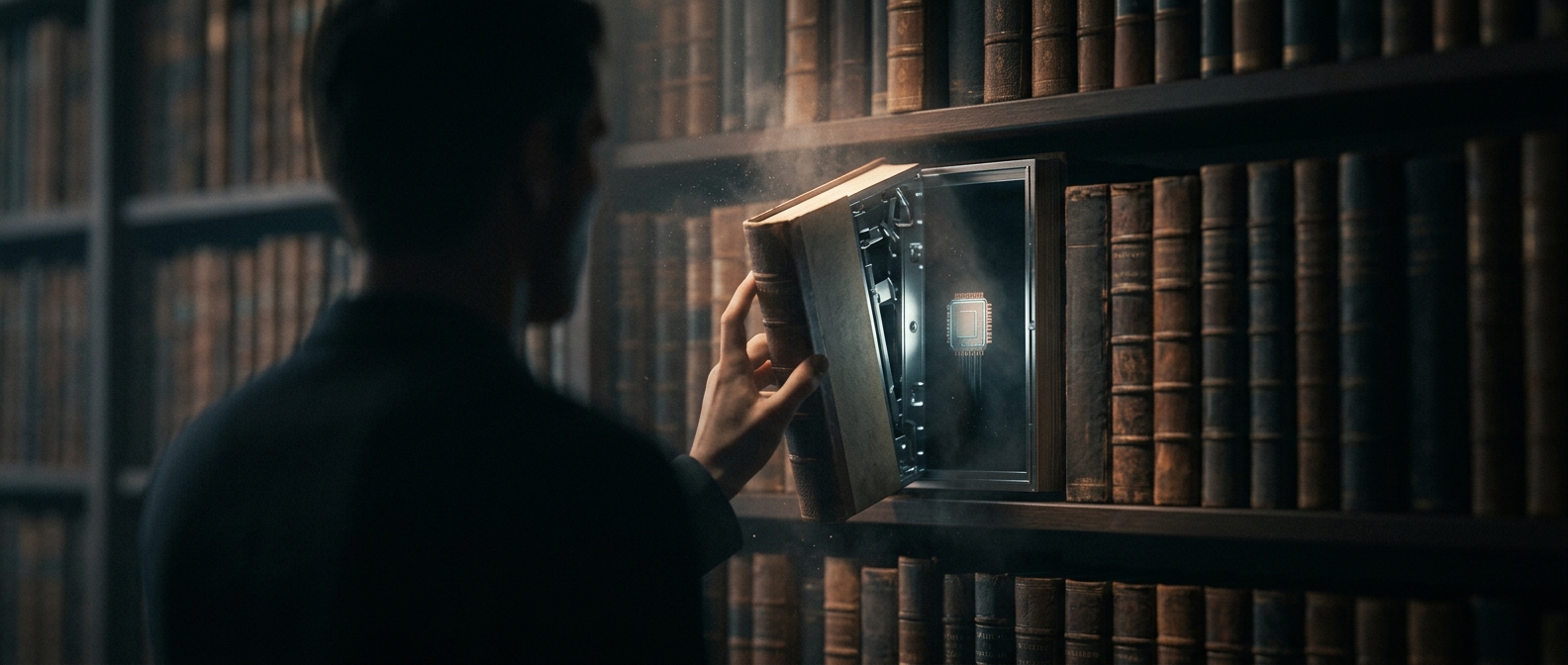
Why a hollowed book can disappear in plain sight
The concealment works because a bookshelf is a familiar visual pattern. Among ordinary spines, a book usually attracts little attention; a box or pouch on the same shelf would look like something placed there to be found. The disguise depends less on making the object invisible than on making it seem unremarkable.
Inside, the pages are cut or removed to create a cavity, while the remaining cover and spine preserve the book’s outward shape. The hollow can hold small items such as folded cash or a key. Its size is limited by the book, and a narrow opening makes it harder to place or retrieve anything bulky.
The disguise has to survive handling
A convincing book safe needs to look and behave enough like a book to fit its surroundings. A visibly altered spine, an unusually heavy cover, or pages that shift oddly can draw attention. Keeping it among similarly sized books—and choosing a volume that does not seem out of place there—helps the disguise make sense at a glance.
There is also a practical tradeoff: cutting away pages creates space but removes the book’s ordinary contents and can weaken its structure. A hollowed book is therefore best suited to small items that need a discreet place, not to anything that must be accessed quickly or stored in large quantities. Its useful trick is simple: the hiding place is concealed by an object people already expect to see.