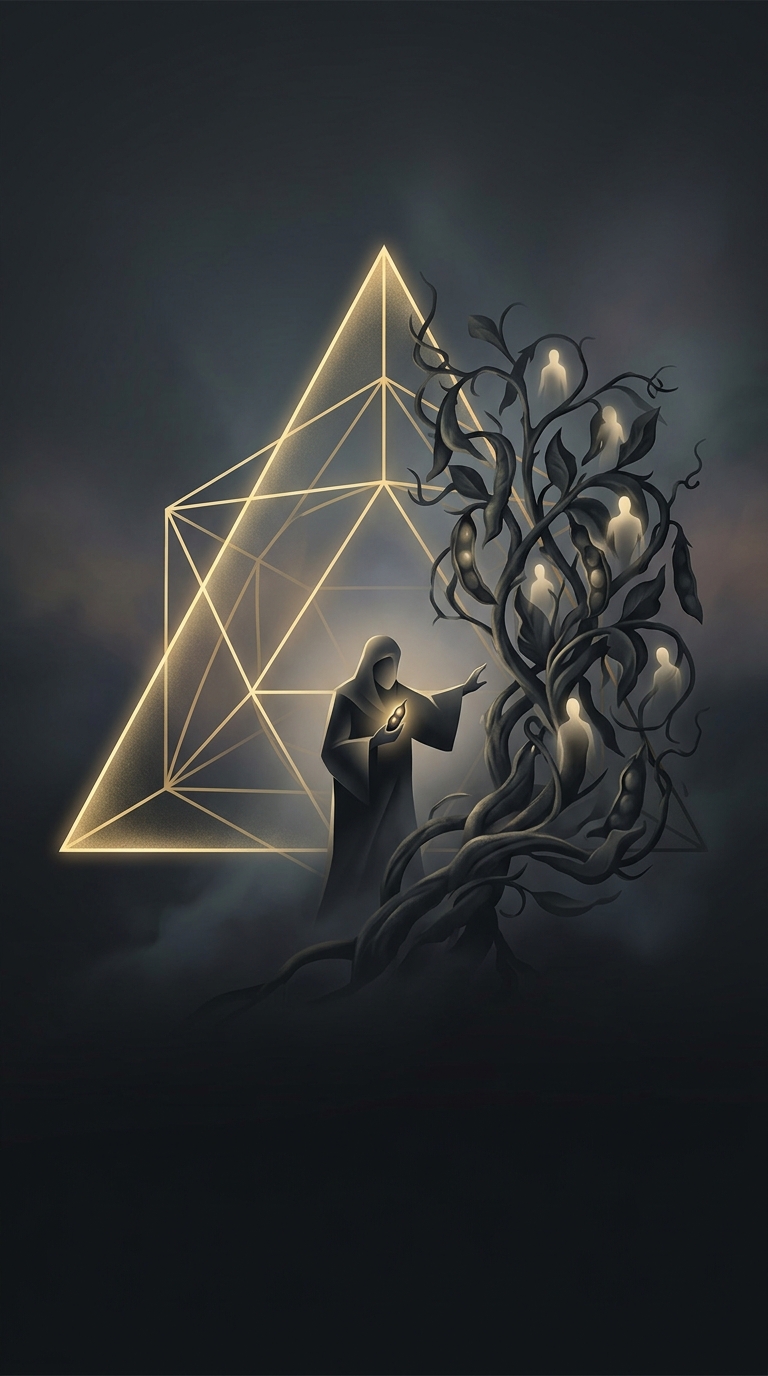
A mathematical school with rules for the soul
The early Pythagoreans were not simply mathematicians gathered around a famous theorem. They formed a disciplined community whose members treated the order of the universe as something to study—and live by. Their belief in transmigration, the passage of a soul from one body to another after death, made ordinary choices about food and conduct part of a much larger question: what kinds of life might a person enter next?
That belief helps explain why reports of Pythagorean food taboos attracted attention. Abstaining from a food could serve as a rule of spiritual discipline, but the surviving accounts do not give one consistent explanation for the prohibition on beans. Ancient writers linked it variously to the soul, to the bean’s resemblance to human forms, or to practical and ritual concerns. Those explanations are reports about the group, not a single securely established doctrine.
How a bean became part of the legend
Stories about Pythagoras’ death turn the taboo into a dramatic test. In one version, he refuses to cross a bean field while escaping pursuers and is killed. The tale makes his commitment instantly legible: he would rather face danger than violate a rule. But ancient accounts differ, and the story is best understood as a memorable tradition about Pythagorean discipline, not a firmly verified final scene.
The bean episode survives because it reveals how far the school’s philosophy reached. For its followers, ideas about the soul were not abstract speculation; they could shape what one ate, where one walked, and what risks one would accept.