A ritual leader with a constructed identity
MacGregor Mathers was not simply an eccentric dressed for the street. He helped found the Hermetic Order of the Golden Dawn, a secretive late-Victorian society whose members studied ceremonial magic, astrology, and related esoteric traditions. Within such groups, robes, titles, and carefully staged rituals helped make abstract teachings feel like an ordered world with its own ranks and symbols.
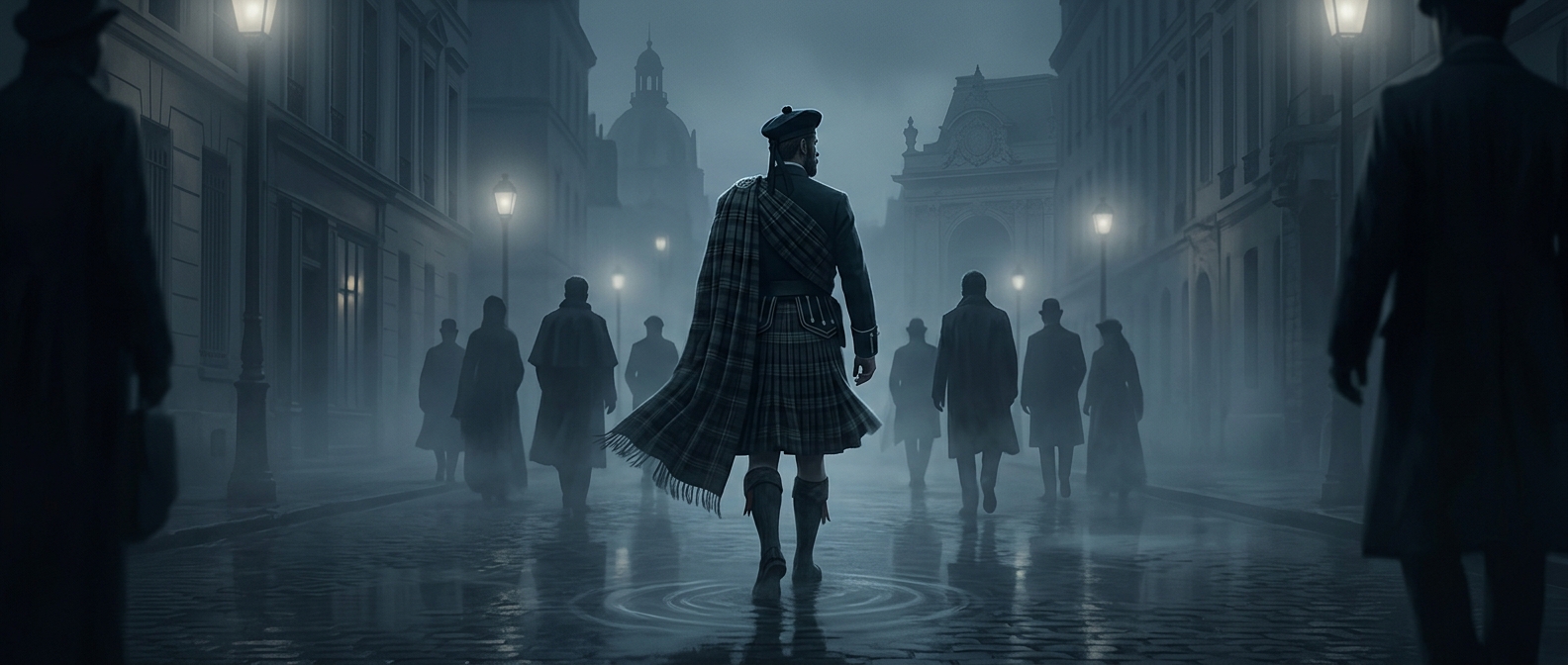
Mathers’s Highland clothing gave that world a conspicuous public face. The name “MacGregor” and the regalia presented him as connected to a Scottish lineage he claimed, though he was born in London. The costume did not establish that ancestry; it made the identity visible. In Paris, where he continued occult work after leaving Britain, a kilt and dirk could turn an otherwise private authority into a striking street presence.
From ceremony to personal danger
The same boundary between symbolism and ordinary life could blur in Mathers’s own account of events. He said vampires and rival magicians were attacking him psychically. Those statements are evidence of what he believed or reported, not proof that such attacks occurred. They also show how the occult framework surrounding him could shape the way he interpreted conflict: hostility might be understood not only as a dispute between people, but as an unseen magical assault.
That combination—public ritual costume and private supernatural threat—helps explain why Mathers remains memorable. His appearance made the secret society’s symbolic world visible on Paris’s streets, while his claims reveal how seriously he treated that world beyond the ceremony.