How Laser Light Can Slow an Atom
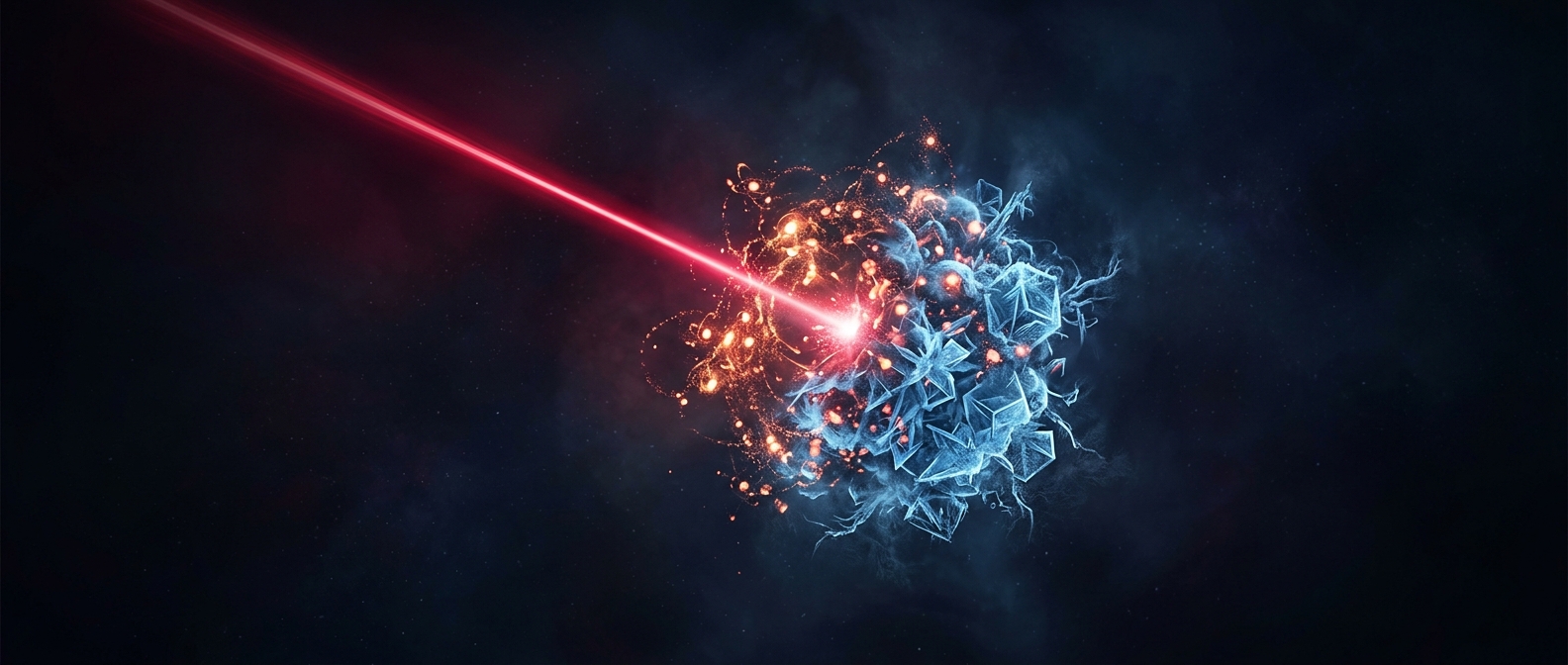
A laser beam carries momentum, even though light has no rest mass. When an atom absorbs a photon—a particle of light—it receives a tiny push in the photon’s direction. One push is minuscule, but repeated many times, carefully aimed pushes can slow a moving atom.
The trick is to make the atom absorb light mainly when the push will oppose its motion. Physicists tune the laser’s color slightly below the frequency the atom naturally absorbs. An atom moving toward the beam sees its light shifted toward that preferred frequency, so it is more likely to absorb a photon. The photon’s push then acts like a brake.
A Brake Made of Beams
Absorption alone would eventually stop working as the atom slowed. But after absorbing a photon, the atom soon emits another as it releases the energy. That emitted light goes in a random direction, while the laser’s incoming photons keep pushing against the atom’s motion. Across many absorption-and-emission cycles, the random kicks mostly cancel out; the repeated braking pushes do not.
Beams aimed from opposite directions can slow atoms moving either way. This method, called Doppler cooling, reduces the atoms’ motion so much that they reach temperatures far below those of ordinary cold materials.
The cooling has limits: atoms still recoil when they absorb or emit individual photons, so their motion cannot be reduced to absolute stillness this way. And the result is a cloud of chilled atoms, not an everyday object cooled by shining a laser on it. The light works as a brake because the laser’s frequency is tuned to the atoms’ motion.