How the Eye of Horus Became a Measuring Aid
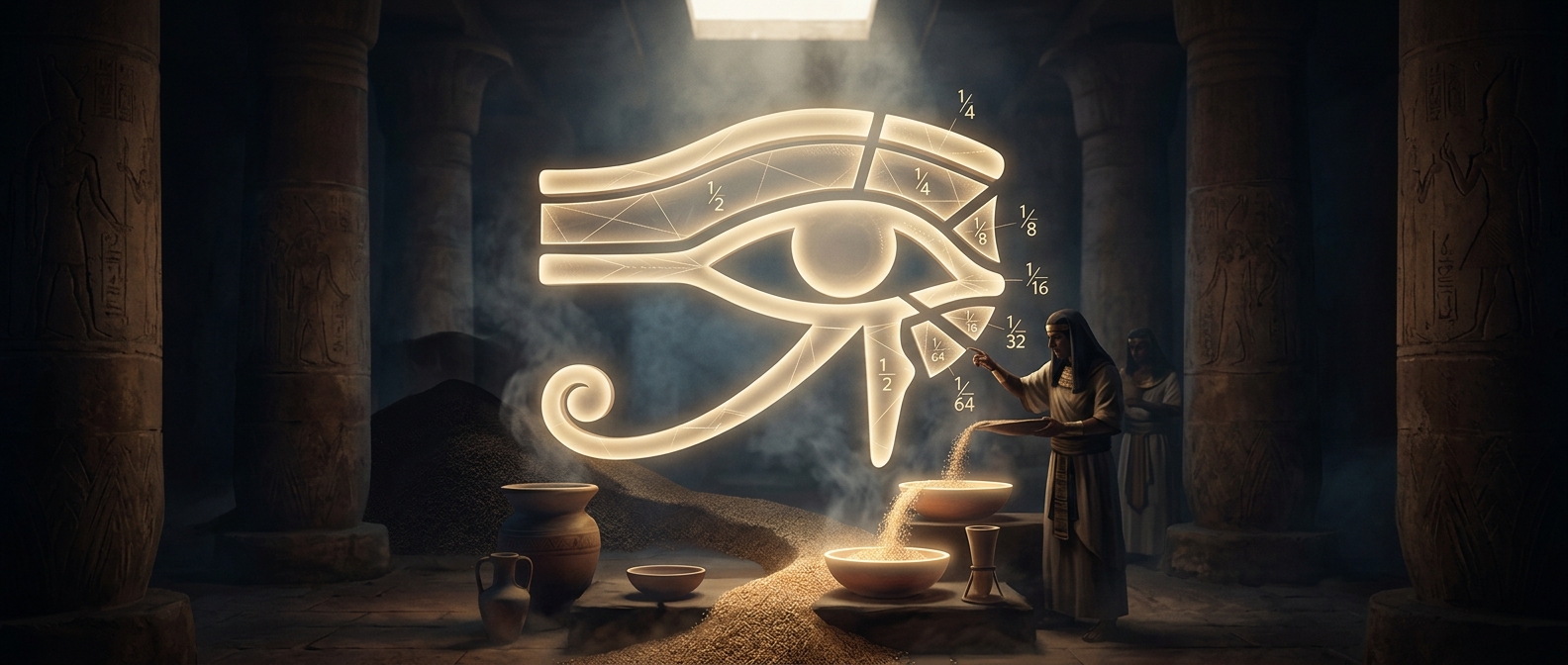
In ancient Egypt, grain had to be counted as well as grown. Officials measured crops and food stores in units such as the heqat, a measure of volume. The Eye of Horus was later associated with a set of fractional values useful for dividing those quantities: its parts stood for halves, quarters, eighths, and progressively smaller portions down to 1/64.
The scheme is often described as a practical shortcut for handling grain fractions. Instead of writing every amount as an abstract fraction, a scribe could use familiar signs linked to portions of the eye. The symbols gave a memorable visual structure to calculations involving measured goods.
A Fractional System With a Symbolic Remainder
The six values—1/2, 1/4, 1/8, 1/16, 1/32, and 1/64—add up to 63/64, not a whole. In the traditional explanation, the missing 1/64 was supplied by Thoth, the god associated with knowledge and calculation. That detail ties the arithmetic to the Eye of Horus’s mythic story of an eye damaged and restored.
The connection between the eye’s individual parts and this exact fraction sequence is familiar from explanations of Egyptian mathematics, though surviving evidence does not make every part of the story equally certain. What is clear is why the pairing endured: a symbol of restoration could also serve as a compact way to think about dividing and accounting for valuable stores.
From Symbol to Storehouse
A fraction of a heqat was not just a number on a page. It could represent grain owed, received, or distributed. Linking fractions to a recognizable image made the abstract business of measurement easier to organize—and gave a practical accounting tool a meaning that reached beyond arithmetic.