How a lab isolates a drug’s active ingredient
A tablet or liquid contains more than its active drug. Fillers, coatings, preservatives, and breakdown products can all contribute to a sample’s chemical signal. Measuring the mixture as a whole would not reveal which part came from the ingredient responsible for the drug’s effect. Chromatography solves that problem by separating the compounds before they are measured.
Why the compounds emerge at different times
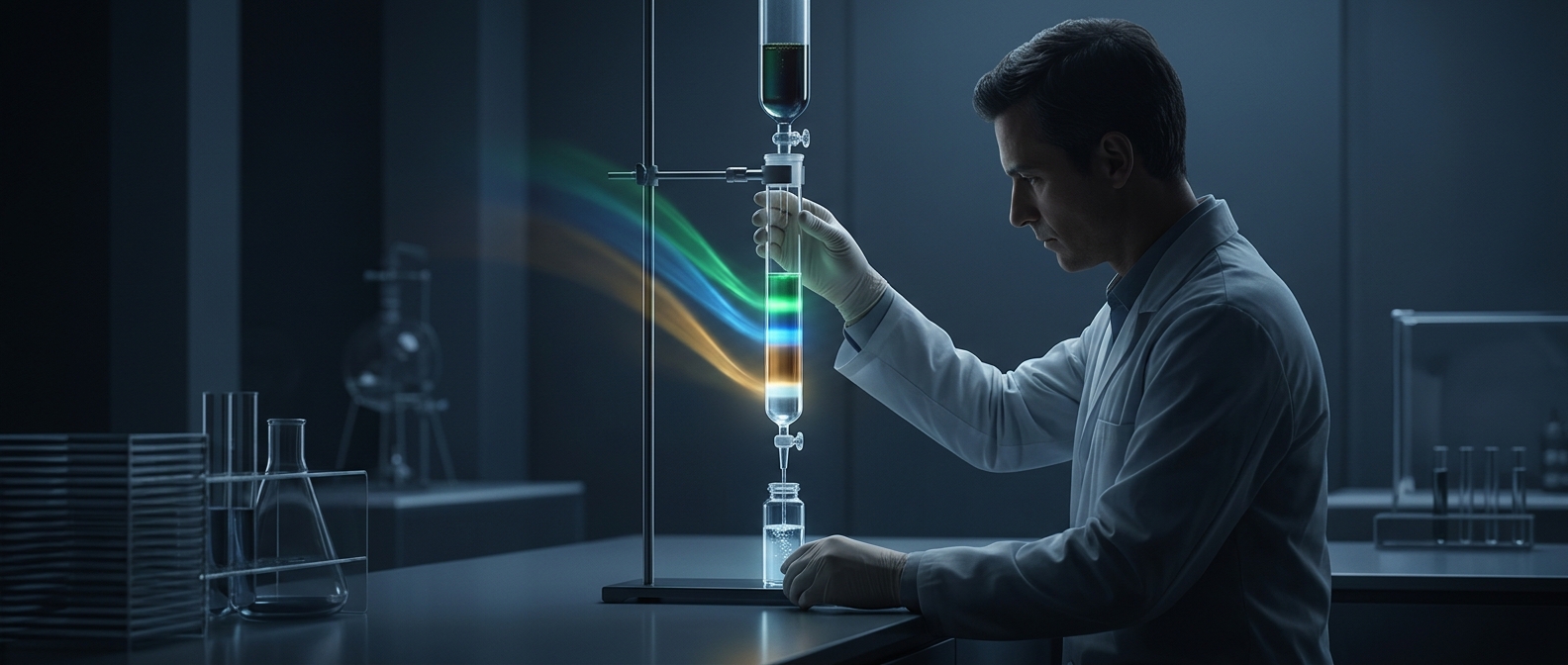
In high-performance liquid chromatography, a pump pushes a liquid carrying the dissolved sample through a tightly packed column. The column’s material interacts differently with different compounds. Some spend more time sticking to it; others remain in the moving liquid and travel onward more quickly. As a result, the compounds leave the column at distinct times, called retention times.
A detector records each compound as it exits, producing peaks on a graph. A peak’s position helps analysts identify a substance by comparison with a known reference, while its size provides a measure of how much is present. To turn that signal into a concentration, the lab compares it with reference samples containing known amounts of the active ingredient.
From a chemical peak to a quality check
The result can show whether a sample contains the expected amount of active drug and whether other detectable compounds are present. That matters because too little active ingredient may fail to deliver the intended dose, while too much can raise the risk of harm. Chromatography also helps distinguish a genuine ingredient from chemically similar substances or products formed as a drug degrades.
The method does not make a sample safe by itself; it gives analysts a more specific measurement than testing the mixture in one undivided signal. The crucial step is separating the active ingredient from everything traveling alongside it—so the reported concentration reflects the drug, not the tablet around it.