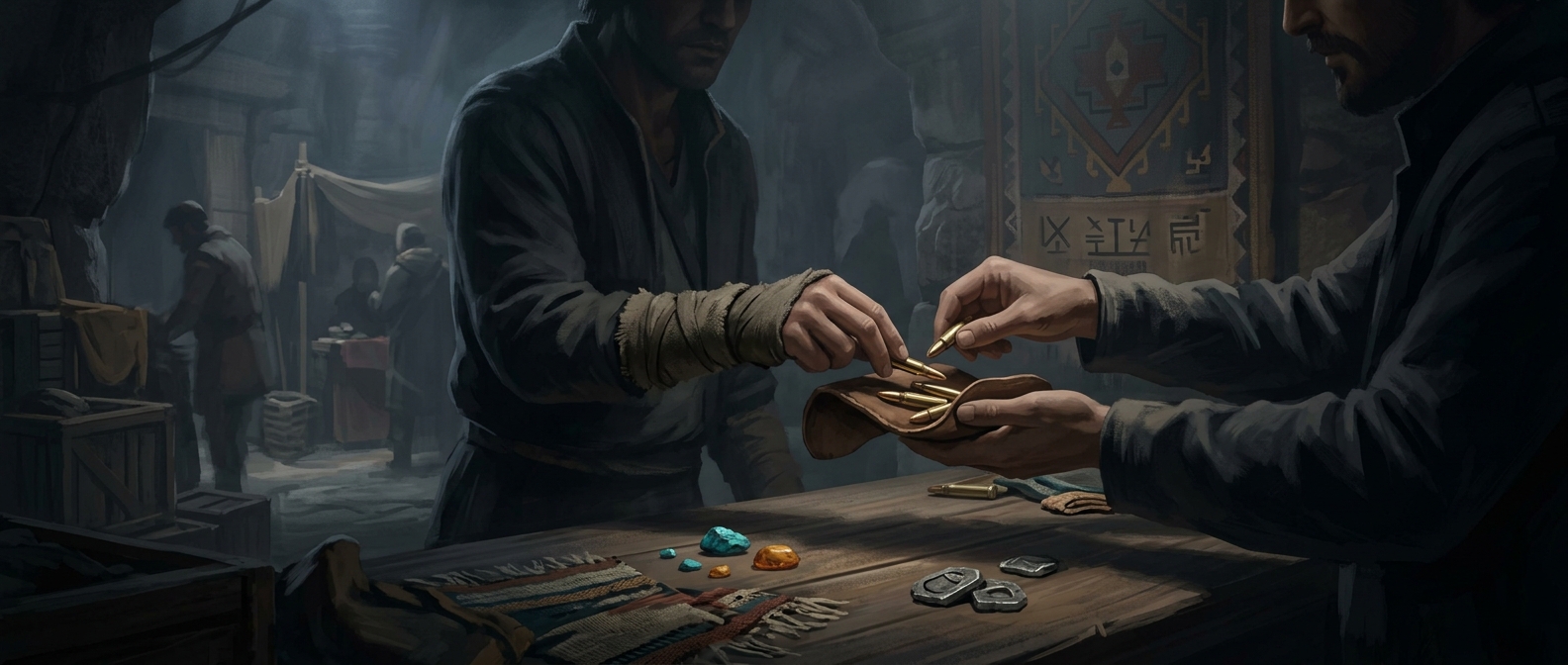
Why a cartridge could count as change
For an exchange to work, both sides must agree that the item handed over has value beyond the immediate trade. Where coins are hard to obtain, a standardized ammunition cartridge could fill that role: it was useful in its own right, recognizable to people who used the same kind of firearm, and small enough to pass from one person to another.
That usefulness gave a round a kind of built-in demand. A shopkeeper accepting one for bread might later trade it to someone who needed ammunition. Unlike a promise to pay, the cartridge was a tangible object with practical use—though its value depended on someone wanting that particular type.
The limits of pocket-size money
Ammunition was not interchangeable in the way a coin of a known denomination is meant to be. A cartridge for one firearm may not work in another, and damaged or unsuitable rounds may be worth little. People therefore had to recognize what they were receiving and trust that it was usable. The item’s value could also shift with local supply and demand.
Using ammunition as change was a response to a shortage of ordinary money, not a frictionless replacement for it. A baker could make a small sale without coins, but the customer might leave with something useful only to a narrower circle of people—and something that had to be handled and stored carefully. In that exchange, a bullet did double duty: it settled today’s bill and carried tomorrow’s bargaining power.