A riff became the song’s spine
The session’s lasting idea was not a finished lyric or a carefully mapped-out arrangement. It was a bass figure: a compact, repeating pattern that could hold the music together while the singers tried different phrases above it. Repetition gave the group a stable foundation, even as the rest of the track took shape through improvisation.
That kind of musical anchor matters in a jam. Players can change chords, rhythms, and vocal ideas without losing the thread, because the bass keeps returning the song to a recognizable point. Here, the riff’s insistent pulse helped turn a loose studio experiment into a track with a strong identity.
Two voices, one shifting conversation
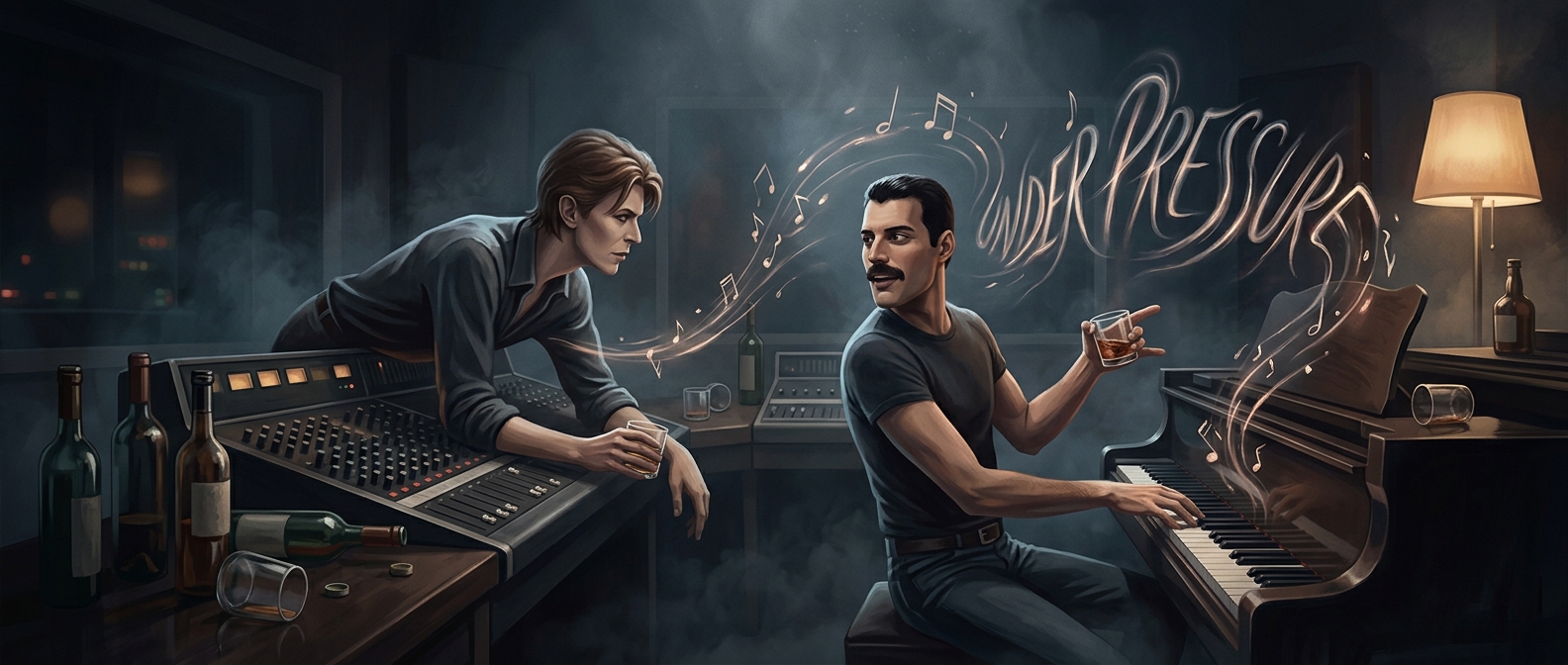
Rather than placing David Bowie in a conventional guest-singer role, the arrangement lets him and Queen’s Freddie Mercury trade vocal lines. The handoffs make the performance feel like a conversation: one voice sets up a thought, and the other answers or redirects it. The singers’ contrasting styles become part of the structure, not just a decorative feature.
That approach also gave the musicians room to build the song by feel. A recurring bass pattern could stay constant while the vocal exchanges changed, making an improvised collaboration sound deliberate and cohesive. The result preserves some of the spontaneity of the session without requiring the finished track to sound like an unedited rehearsal.
Why the session’s blur fits the record
Accounts of the recording describe a session so hectic that the musicians later had trouble recalling how they had made the song. The finished recording, however, turns that looseness into a clear musical design: a persistent low-end hook, shifting layers, and two prominent voices passing the lead back and forth. The chaos supplied the raw material; the repeating riff and vocal handoffs gave it shape.